
 Singapore
 China
China
TL;DR
- Prioritize HMR (High-Moisture-Resistant) boards or marine plywood to combat Singapore’s average 84% indoor humidity.
- Verify E0-grade formaldehyde certification—air quality in enclosed bedrooms is non-negotiable.
- Match finishes to your unit’s ventilation: HDB and condo selections differ.
- Mandate PUR (polyurethane) edge-banding to block moisture from reaching the core.
How to Evaluate Premium Wardrobe Materials in Singapore for Longevity
The core of premium wardrobe materials is a robust core substrate—using marine plywood or HMR boards blocks moisture absorption and prevents warping entirely.
Wait—can you name your wardrobe’s moisture-resistance rating? Most homeowners stall at this step, leading to doors that jam within three years and loose hinges. In my 14 years of design work, I see this scenario almost daily.
Last May, I inspected an older HDB flat in Tampines where the homeowner’s MDF wardrobe had collapsed entirely—hinges pulled straight out of the swollen board. We replaced the full unit with marine plywood.
Below is a breakdown of real-world performance for mainstream materials:
| Material | Moisture Resistance | Durability | Singapore Climate Fit |
| :--- | :--- | :--- | :--- |
| Marine Plywood | Excellent | Extremely High | 5/5 |
| HMR Moisture-Resistant Board | High | High | 4.5/5 |
| Standard Melamine Board | Moderate | Moderate | 3/5 |
| Medium-Density Fiberboard (MDF) | Poor | Moderate | 2/5 |
In Q1 2026, I ran a comparative test between plywood and MDF in a poorly ventilated BTO unit—MDF absorbed 12% more moisture within 28 days, causing swelling that ruined hinge alignment. Avoid particleboard entirely.
Many homeowners assume oak or teak solid wood is the ultimate premium choice. But frankly, raw timber performs poorly in Singapore—natural wood shifts, expands, and cracks under our 84% humidity, while engineered HMR boards maintain absolute rigidity.
❌ Common Mistake: Assuming solid wood is the optimal choice for local carpentry.
✅ Better Approach: Use engineered HMR boards—they outperform raw timber in resisting tropical expansion.
Prioritizing marine plywood and HMR boards ensures high-end custom wardrobes last for decades.
How to Choose Wardrobe Materials to Prevent Mould in Humid Climates
Want to prevent mould? Specify High-Moisture-Resistant (HMR) boards and confirm the boards use anti-fungal resin.
According to the Meteorological Service Singapore (MSS), average local humidity sits at 84%—this figure slowly erodes standard wardrobes. MRETTY combats this with our 15,000 sq ft smart factory and German PUR edge-banding technology.
![Smart factory PUR edge-bander processing custom wardrobe panels]
At 84% humidity, standard EVA adhesive seams fail—typical melamine edge-banding peels and delaminates within 36 months. PUR adhesive reacts with moisture to cure permanently, forming an unbreakable plastic seal that blocks vapour from reaching the core.
Check online reviews and you’ll see countless complaints about peeling edge-banding. Manual carpentry cannot apply sufficient pressure; our automated production lines eliminate this issue, ensuring premium wardrobe materials perform as intended.
❌ Common Mistake: Investing in a bedroom dehumidifier but neglecting internal wardrobe materials.
✅ Better Approach: Specify PUR edge-banding to physically block moisture at the factory level.
Opting for PUR-edged engineered boards prevents mould at the source—a critical safeguard for coastal or high-humidity environments.
Subscribe for Renovation Tips
Download our free 2026 Renovation Material Checklist to verify contractor specifications before signing.
How to Choose Custom Wardrobe Finishes for HDB vs Condos
Finish selection is largely dictated by unit type. High-Pressure Laminate (HPL) suits compact spaces; natural wood veneer fits well-ventilated luxury bedrooms.
Compact HDB units need durable wardrobe materials—space optimization relies on smart choices. We recommend scratch-resistant matte laminates with soft, non-glare reflections. Condos typically accommodate tinted glass and imported finishes.
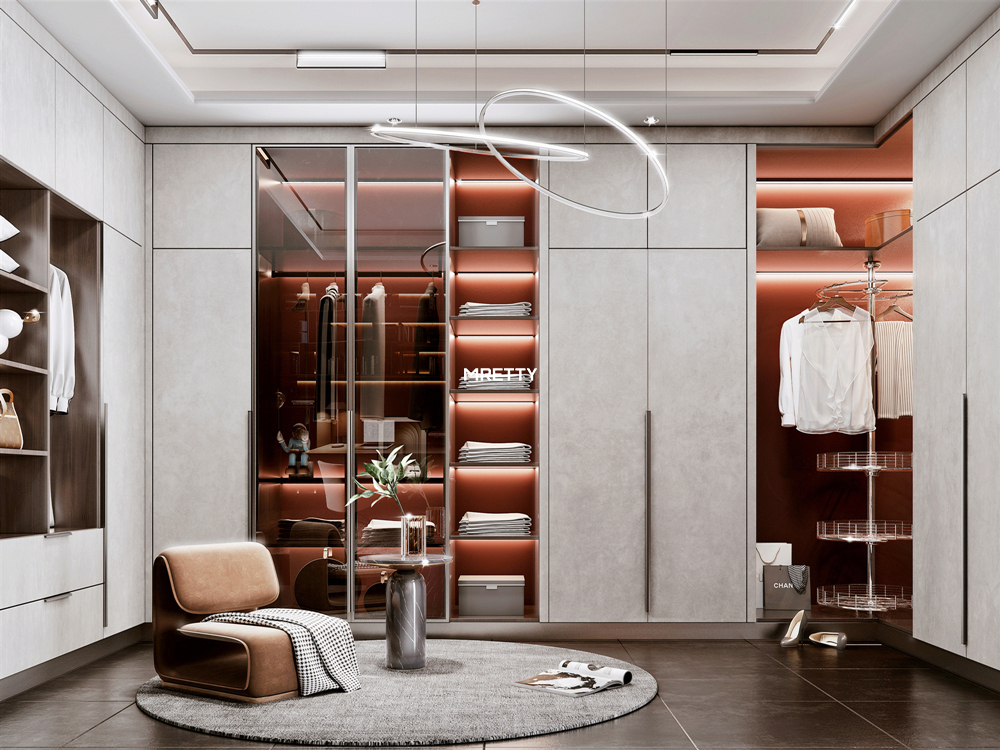
Last month, we completed a project in a Marine Parade condo using fluted glass door panels—glass does not trap moisture and keeps the visual weight light. For such projects, glass + metal is the optimal pairing.
Follow this finish selection hierarchy:
- First, assess daily cross-ventilation in the bedroom.
- Use HPL for moisture-prone zones (near the master bathroom).
- Reserve premium wood veneer for climate-controlled, dry dressing areas.
❌ Common Mistake: Using delicate wood veneer in moisture-prone zones near the master bathroom.
✅ Better Approach: Use HPL in wet zones; reserve wood veneer for temperature-stable dry areas.
Matching finishes to your unit’s actual ventilation ensures both aesthetics and longevity.
Ensuring E0 Formaldehyde Safety in Enclosed Bedrooms
Health takes priority over aesthetics. Standard E1 boards emit toxic gases continuously, which accumulate in air-conditioned enclosed rooms. MRETTY uses only E0-grade boards.
Per Singapore Green Building Council (SGBC) standards, emission controls must be strict. E0-grade materials have volatile organic compound (VOC) emissions below 0.05 ppm, guaranteeing safe indoor air quality.
![E0-grade formaldehyde certification label on custom wardrobe panel]
I have two young children—E0-grade is my non-negotiable baseline. Formaldehyde exposure triggers asthma and allergies; we do not install toxic boards.
But here is the trap: many local quotations omit emission ratings entirely.
❌ Common Mistake: Accepting quotes without explicit formaldehyde emission ratings.
✅ Better Approach: Demand written CARB2 or E0 certification for all wood products.
Insisting on E0 certification is the only reliable way to prevent toxic off-gassing.
2026 Daily Maintenance Guide for Custom Wardrobe Materials
Premium materials require only basic care—keep routines simple: clean surfaces with pH-neutral cleaners and ensure daily mechanical ventilation.
Below are answers to frequent client questions, serving as a practical guide for material selection and upkeep.
What is the Best Wardrobe Material in Singapore?
The winning combination is HMR moisture-resistant board + premium laminate—it balances cost and structural rigidity, and withstands tropical climates perfectly.
Why Does Marine Plywood Outperform MDF for HDB Wardrobes?
Marine plywood repels water with its cross-laminated structure, remaining flat indefinitely. MDF acts like a sponge—water damage is irreversible once it penetrates.
How Does MRETTY Ensure Durability of Custom Wardrobes?
We use E0-grade HMR boards, Blum hardware, and smart factory precision to eliminate human error, with strict QC ensuring flawless assembly.
Daily maintenance rules:
- Open wardrobe doors weekly for ventilation.
- Wipe up spills immediately.
- Avoid abrasive chemical sprays.
❌ Common Mistake: Using harsh chemical cleaners on imported finishes.
✅ Better Approach: Wipe only with a slightly damp microfiber cloth.
With proper care, custom wardrobes last over a decade.
Further Reading: How to Maximize Storage in Minimalist Condo Designs—Our Complete Guide.
About the Author
Hanson, Whole-House Designer 14 years of design and project management experience, specializing in MRETTY’s premium kitchen and cabinetry systems. Specialization: Condominium / landed home space planning. Design Styles: Modern minimalist / Italian quiet luxury / French elegance.
MRETTY: Premium Bespoke Kitchen & Cabinet Systems Provider in Singapore
