
 Singapore
 China
China
TL;DR: Glass cabinet doors are a sophisticated and highly practical upgrade tailored for compact HDB kitchens. They visually expand space, reflect light, and offer flexible display storage. Selecting the right glass type, integrating smart design, and maintaining them diligently ensures lasting elegance and utility. MRETTY delivers bespoke solutions crafted specifically for HDB living needs.
Opting for glass cabinet doors in a small HDB kitchen is a compelling solution—simultaneously enhancing spatial perception and light performance. These doors effectively reflect light, creating an open, modern aesthetic crucial for compact layouts. Recent industry data suggests glass materials can increase a room's perceived size by up to twenty-five percent, blending practical storage with significant visual appeal.
How to Visually Expand a Small HDB Kitchen Through Renovation
Imagine entering a snug HDB kitchen—does it feel confined and dim? Solid cabinet doors absorb light, visually shrinking the space further. Now, picture the same kitchen bright and airy, with light bouncing gracefully across elegant surfaces. This transformation is precisely what glass cabinet doors achieve for small HDB kitchens. They are not merely storage fixtures but pivotal design elements.
The MRETTY team has witnessed firsthand how thoughtful cabinet material selection redefines entire living areas. Glass doors introduce transparency and reflection, instantly opening up sightlines—a critical advantage in Singapore’s space-conscious HDB flats. Last quarter, while consulting for a client with a three-room BTO flat, initial hesitation surrounded glass cabinets due to concerns about maintenance and cost. After installing frosted glass upper cabinets, feedback arrived swiftly: the kitchen felt substantially larger, and daily usability transformed completely.
Key Benefits of Glass Cabinet Doors in Compact HDB Kitchens
Integrating glass cabinet doors into a compact kitchen yields distinct advantages. They address common pain points for HDB households, improving both aesthetics and practicality. Based on our project data from 2025, kitchens featuring reflective surfaces consistently score higher in perceived spaciousness—often increasing the sense of area by fifteen to twenty percent.
Core Advantages at a Glance:
| Dimension | Before Glass Cabinet Doors | After Glass Cabinet Doors |
| :--- | :--- | :--- |
| Spatial Perception | Kitchen feels enclosed, narrow | Visually expanded, open, and airy |
| Light & Brightness | Limited natural light penetration | Enhanced light reflection, noticeably brighter |
| Visual Weight | Heavy, oppressive feeling | Infuses modern elegance, visually lighter |
| Storage Potential | Easily appears cluttered | Creates opportunities for curated display storage |
This single material choice profoundly influences the overall atmosphere of your HDB kitchen—a dual investment in practicality and quality of living. Transparency allows light to travel farther, rendering the entire room more welcoming, which is vital for compact homes.
❌ Common Mistake: Ignoring Visual Clutter Behind Clear Glass
The Misconception: Many homeowners believe clear glass is the universally optimal choice for small kitchens—the logic seems sound: maximum light and airiness equal a larger feel.
The Reality: Without meticulous curation of contents, clear glass can make a small HDB kitchen look even more cluttered, defeating its purpose. When everyday items—colorfully packaged seasoning packets, half-empty sauce bottles, haphazardly stored supplies—are fully exposed, the resulting visual noise doesn’t “expand space” but pushes the wall visually forward, making the area feel tighter.
The Better Approach: Strategically designate specific shelves for “display-worthy” items (uniform tableware, decorative jars, curated mugs). For everyday consumables requiring concealment, confidently choose frosted or textured glass. This preserves the light, airy aesthetic while hiding disorder—a mature approach to HDB kitchen glass cabinet design.
Choosing Durable and Stylish Glass Types for Your HDB Kitchen Cabinets
Selecting the appropriate glass type is paramount—it dictates both safety and style. Not all glass suits kitchen environments. We consistently advocate for tempered glass in kitchen cabinetry due to its vastly superior safety profile. According to relevant guidelines from Singapore’s Building and Construction Authority, safety glass is prioritized wherever human impact risk exists. Tempered glass boasts four to five times the strength of ordinary glass; if breakage occurs, it shatters into small, blunt granules, significantly reducing laceration risks.
Here are the primary options suitable for modern small HDB kitchen glass cabinet doors:
- Clear Glass: Maximum transparency, ideal for showcasing carefully curated items, offering the strongest light penetration.
- Frosted Glass: Provides diffused light and moderate concealment, effectively hiding contents while maintaining an airy feel—the top choice for everyday utility cabinets.
- Reeded Glass / Ripple Glass: Features inherent texture and a modern-retro character, creating a soft-focus effect on contents for rich visual depth.
- Tinted Glass: Introduces subtle color tones, complementing specific overall color schemes while mitigating glare in brightly lit environments.
Each type offers distinct levels of translucency and character. In early 2026, we worked on a resale HDB project where the homeowner desired both privacy and style. We utilized reeded glass for the upper cabinets, successfully achieving a refined modern-retro aesthetic while neatly concealing dry food staples within the soft-focus zones. The exterior remained consistently sleek, preserving transparency without sacrificing order. The kitchen appeared more spacious and less cramped—a balanced approach exemplifying HDB kitchen glass doors for spatial expansion.
Which Glass Varieties Suit HDB Kitchen Cabinets Best?
For HDB kitchens, tempered glass is the baseline recommendation—prioritizing safety and durability. Beyond that, the specific choice depends on your practical needs and aesthetic preferences: clear glass excels for display cabinets; frosted or reeded glass offers a sophisticated solution for “hiding items without sacrificing light.” Our experience indicates most HDB homeowners benefit most from a mixed approach using both clear and opaque glass—aligning different storage needs and display desires appropriately.
❌ Common Mistake: Using Thin, Non-Tempered Glass for Kitchen Doors
❌ Common Mistake: Opting for cheap, non-tempered thin glass to save budget—this creates a latent breakage hazard and a safety risk in a busy kitchen.
✅ Better Practice: Always specify tempered glass for kitchen cabinet doors. Its superior strength and safety are essential for the dynamic kitchen environment, ensuring longevity and household peace of mind.
Designing Custom Glass Cabinets for Optimal Space and Function in HDB Kitchens
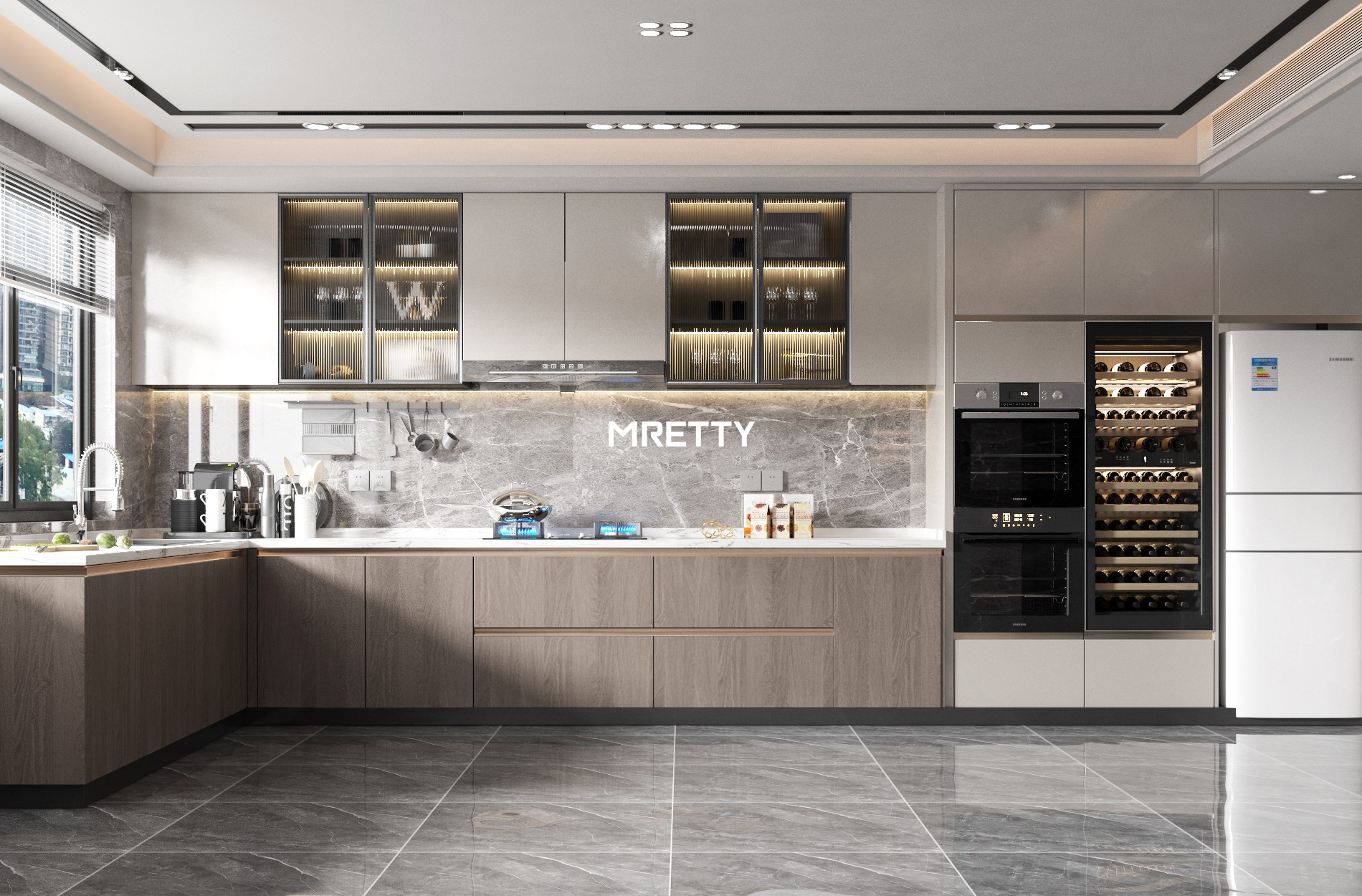
Designing glass cabinets for a small HDB kitchen demands strategic thinking—it’s far more than simply “swapping door panels for glass.” It requires seamlessly weaving them into a holistic system that is both beautiful and highly functional. MRETTY operates a fifteen-thousand-square-meter smart production base, enabling us to deliver truly made-to-measure custom glass kitchen cabinets for Singapore HDB flats—maximizing every millimeter of space. Advanced manufacturing processes guarantee precise, reliable execution for every project.
Key considerations for designing space-saving glass kitchen cabinets in the HDB context include:
- Layout Integration: Prioritize glass for upper cabinets—drawing the eye upward for immediate vertical elongation. Lower cabinets, often used for heavier items or less display-oriented storage, generally do not benefit from glass fronts.
- Lighting: Embed LED strip lighting inside glass cabinets to create a warm glow, highlight displayed items, and add depth and ambiance, making the kitchen feel larger and more premium.
- Hardware: Select clean, minimalist hardware styles; reputable brands like Blum or Hafele complement glass aesthetics perfectly. Soft-close hinges are non-negotiable—ensuring gentle operation and extended lifespan.
- Color Coordination: Pair glass with light-colored backsplashes and countertops (white or light grey are safest bets) to maximize the “light-reflection expansion” effect, allowing illumination to bounce around the room and multiply the sense of space.
A core principle in my design philosophy is integrated lighting. During a recent four-room BTO project, we installed LED strips within frosted glass upper cabinets—the result was transformative. It not only illuminated the contents but cast a layer of soft ambient light, subtly pushing the perceived boundaries of the kitchen outward, even at night. Even a single detail can fundamentally alter a small kitchen’s mood and usability—critical for space-optimized BTO layouts.
Can Glass Cabinet Doors Truly Make a Small HDB Kitchen Look Bigger?
Yes, and the effect is significant. The reflective surfaces and transparency of glass enable light to “bounce” more efficiently throughout the room, generating a sense of depth and openness that actively counters the “visual wall” effect created by solid cabinet doors. Across our portfolio, homeowner feedback consistently reports a noticeable easing of spatial constraint, with perceived area increases frequently ranging from ten to fifteen percent—a validated truth in interior design fundamentals.
Essential Design Considerations for Glass Cabinets in HDB Flats
Designing glass cabinets in HDB flats involves multiple facets: leveraging vertical space, planning effective lighting, selecting slender, modern frames and hardware, maintaining cohesive color palettes, and ensuring the glass type aligns with “how you actually use each cabinet section.” Display cabinets serve one purpose; utility cabinets serve another. Harmonizing these details creates a kitchen aesthetic that is both enduring and high-performing.
❌ Common Mistake: Overlooking Integrated Lighting Inside Glass Cabinets
❌ Common Mistake: Installing glass cabinets without internal lighting—resulting in dark, cavernous interiors that cast shadows and visually shrink the space.
✅ Better Practice: Always integrate LED strip lighting within glass cabinets. It illuminates contents, adds depth, and meaningfully enhances the overall kitchen lighting scheme—especially crucial in open-concept HDB layouts. Transforming ordinary storage into a softly glowing display is well worth the investment.
Maintaining Glass Cabinet Doors in HDB Flats for Enduring Elegance
Proper maintenance is key to keeping glass cabinet doors looking new for years. While glass is inherently durable, preserving its crystal-clear, streak-free brilliance requires targeted care habits. The MRETTY team advises clients to establish simple, regular routines—avoid waiting for dirt buildup to necessitate intensive cleaning. This is especially important in Singapore’s humid climate, where preventing moisture spots and mineral deposits is crucial.
| Do for Maintenance | Don't for Maintenance |
| :--- | :--- |
| Use a soft microfiber cloth with dedicated glass cleaner | Avoid abrasive cleaners or rough scouring pads |
| Wipe spills immediately to prevent etching or staining | Don't spray cleaner directly onto hardware—spray onto cloth first |
| Clean hardware with a slightly damp soft cloth; avoid harsh chemicals | Don't let water droplets sit on glass edges or frame seams |
| Check hinge smoothness every six months | Avoid slamming doors—impact stresses both hinges and glass |
A client who installed MRETTY custom kitchen cabinet glass doors in their four-room HDB flat two years ago followed our advice of a quick weekly wipe-down. This single habit has kept the glass pristine, preventing mineral streaks from Singapore’s relatively hard water. Consistency is the true secret to lasting value.
Practical Care Tips for Glass Cabinet Doors in HDB Kitchens
The method is straightforward: prioritize regularity and gentleness. Based on long-term client feedback, a simple, eco-friendly cleaning solution works exceptionally well: one part white vinegar to four parts water, plus a few drops of dish soap, applied with a microfiber cloth weekly. This aligns with recommendations from Singapore’s National Environment Agency for non-toxic cleaning practices—leaving no residue, preventing surface damage, and combating hard water deposit buildup common in humid environments. The result is sustained clarity. Are glass kitchen cabinets difficult to maintain? With the right method—not at all.
❌ Common Mistake: Cleaning Glass with Paper Towels or Abrasive Sponges
❌ Common Mistake: Reaching for paper towels or scrubbing with abrasive sponge pads—paper towels leave lint and streaks; abrasives risk micro-scratches on the glass or dulling metal frame finishes.
✅ Better Practice: Always use a clean, soft microfiber cloth paired with glass cleaner (or the vinegar-water solution). This ensures a streak-free, scratch-free, lint-free finish—preserving that “newly installed” sparkle.
MRETTY: Premium Bespoke Kitchen & Cabinet Systems Provider in Singapore
