
 Singapore
 China
China
TL;DR: The Perfect Custom Home Guide at a Glance
- Clarify your needs before meeting your designer to save time and reduce costs.
- Budget between S$45,000–S$75,000 for a comprehensive custom renovation of a four-room HDB BTO flat.
- Verify if your chosen design firm owns its production line; this is critical for quality control stability.
- Always review current HDB and BCA guidelines before approving structural alterations.
Many homeowners mistakenly believe that custom interior design is a luxury reserved for landed properties, often equating it with simply selecting expensive finishes. Having specialized in holistic home solutions in Singapore for 14 years, I can definitively state: this is the biggest misconception. Customization does not equal luxury; customization equals smart planning. It is the art of making every square meter fit your lifestyle. Whether you reside in a 93-square-meter four-room BTO flat or a bungalow in Sentosa Cove, this logic applies universally. It could be a built-in wardrobe that houses your entire wardrobe collection or a culinary system that transforms cooking from a chore into a pleasure. True custom interior design in Singapore solves practical living problems rather than merely focusing on surface aesthetics. At MRETTY, we "engineer" your lifestyle into your living space—a process refined over a decade and backed by our proprietary manufacturing facility.
Deconstructing the Custom Design Workflow for a Seamless Renovation
Custom interior design follows a standardized, end-to-end workflow. From initial conceptualization to the final handover, this process ensures your vision is executed with precision. A typical turnkey renovation cycle spans 8–12 weeks: beginning with deep-dive consultations and culminating in your move into a home built specifically for you. As a designer, my primary task is to understand your living habits. Do you work from home? Do you host frequent family gatherings? Where do you usually leave your laundry basket? These details form the basis of scientific spatial planning. We then produce 3D renderings, allowing you to preview your future home before construction begins. Data from Q2 2026 indicates that clients who invest more time refining plans during the 3D rendering phase reduce mid-construction change requests by 40%. Once the design is finalized, the drawings are sent directly to our 15,000-square-meter smart factory—not outsourced to an unfamiliar external carpenter. This integrated design-and-production model is our core advantage, ensuring that the kitchen carpentry and built-in wardrobes you see in the renderings match the finished products installed in your home perfectly, eliminating information loss. The process concludes with professional installation, defect checks, and formal handover.
What Can a Custom Furniture Designer Offer You?
Do not mistake a custom furniture designer for a mere soft furnishing stylist; they are your personal living problem-solver. They systematically analyze your storage needs, daily circulation, and spatial constraints to create bespoke pieces that balance aesthetics with utility. This includes providing expert advice on material selection to ensure every custom furniture piece in Singapore integrates seamlessly with your home’s overall style. A skilled designer also offers optimization solutions you may never have considered.
Last month, I consulted for a couple living in a four-room BTO flat who constantly complained about a "messy" living room. When asked about their weekend routine, I discovered they were avid board game enthusiasts with over 50 large boxes cluttering their shelves. The solution was not a prettier display shelf but transforming the entire TV feature wall into a full-height unit with hidden drawers at the base, sized precisely to fit the game boxes. Clutter vanished behind the panels, keeping their passion readily accessible. The problem was never "mess," but a mismatch between storage solutions and lifestyle.
❌ Common Pitfall: Rushing initial consultations or arriving unprepared. Many homeowners want to see design proposals immediately without first梳理 (clarifying) their daily pain points.
✅ Better Approach: Prepare a brief requirement sheet listing the three most frustrating aspects of your current home and the three core objectives for your new home. This aligns our first discussion with your actual needs immediately.
A transparent workflow, particularly an integrated pipeline like MRETTY’s with its own factory, minimizes unexpected risks and guarantees the final outcome matches the approved designs.
Precision Budgeting to Prevent Cost Overruns
A reasonable starting budget for custom interior design in Singapore is approximately S$45,000 for a new four-room HDB BTO flat, while landed properties may exceed S$200,000. Understanding the key cost drivers is essential. Your final quote for a Singapore whole-home customization depends primarily on three factors:
- Scope of works (hacking, masonry, electrical rewiring)
- Material grades
- Complexity of carpentry
A common industry myth is that selecting the lowest quote after comparing several bids is the optimal strategy. In reality, this is often a hidden trap. A quote 20% lower than the market average typically signals compromised material quality, inexperienced labor, or hidden costs that emerge mid-project. A high-quality custom renovation for a five-room HDB BTO flat typically ranges from S$60,000–S$90,000. For a standard Singapore condominium (approx. 1,200 sq ft), expect a budget of S$70,000–S$120,000. These figures generally include design fees, project management, E0-grade eco-friendly boards, and premium hardware from brands like Blum or Hafele. Roughly speaking, about 60% of a custom renovation budget is allocated to carpentry and built-in furniture. Opting for a company like MRETTY with its own factory cuts out middleman markups, offering better value.
Key Differences Between Interior Designers and Contractors in Singapore
Interior designers oversee the entire project: spatial planning, aesthetic curation, bespoke solutions, and end-to-end management. Contractors execute the physical work strictly according to approved drawings. While contractors may be cheaper for minor works, designers provide the holistic vision and project stewardship crucial for complex custom renovations.
Sample Budget: S$75,000 for a Five-Room HDB Flat
Here is a typical cost breakdown to help frame your expectations:
Carpentry & Custom Furniture (55%): S$41,250
Hacking & Masonry (15%): S$11,250
Electrical Rewiring (10%): S$7,500
Design, Service & Project Management (10%): S$7,500
* Finishing Works (Ceiling, Painting, etc.) (10%): S$7,500
This breakdown illustrates that carpentry quality is the single most critical factor determining your renovation’s look and longevity.
❌ Common Pitfall: Selecting a firm based solely on the lowest quotation.
✅ Better Approach: Compare quotes against detailed scope-of-work lists. Request itemized pricing and verify all specified material standards. Reputable firms maintain total transparency regarding cost allocation.
Setting a realistic budget is the most critical preliminary step to avoiding renovation anxiety and ensuring quality.
Mastering Regulations for a Compliant and Worry-Free Renovation
Renovation compliance demands strict adherence to HDB and BCA regulations—there is no room for negotiation. This safeguards structural integrity and legal compliance. Professional design firms handle all permit applications, shielding you from fines or enforced rectification. Critically, many homeowners are unaware that rules vary drastically between property types. Alterations permitted in condominiums may be strictly forbidden in HDB flats. An experienced designer proves invaluable here, navigating the complex regulatory landscape for you.
Understanding HDB vs. Condominium Renovation Rules
The core differences lie in structural engineering. HDB imposes stringent controls on removing specific precast concrete walls (official lists of prohibited demolitions are published online). Condominiums offer slightly more flexibility, but all changes require approval from both the Management Corporation and the BCA. For instance, replacing the main entrance door is restricted in HDB flats but allowed in condos. HDB also enforces stricter noise control timings. I prioritize aligning all compliance red lines with clients before drafting spatial layouts.
Navigating BCA and HDB Renovation Permits
Your design firm should manage all BCA and HDB permit applications. Most HDB renovation works require permits submitted by registered contractors. Any property type involving major structural changes (e.g., removing load-bearing walls) requires BCA approval, usually necessitating structural engineer reports. The golden rule is to finalize all designs before submission. Mid-process drawing changes cause significant delays; we provide full coordination support for these regulatory bottlenecks for all MRETTY clients. ❌ Common Pitfall: Assuming contractors are familiar with and will adhere to all rules. Unlicensed contractors might promise illegal hacks to win projects, leaving you liable for penalties. ✅ Better Approach: Only engage HDB-licensed and BCA-registered firms. Request and verify their license numbers. Reputable companies proactively reject non-compliant requests to protect your interests and property value. Partnering with a team well-versed in HDB and BCA regulations is the safest path to a beautiful and lawful home.
Scientific Material Selection for a Home That Stands the Test of Time
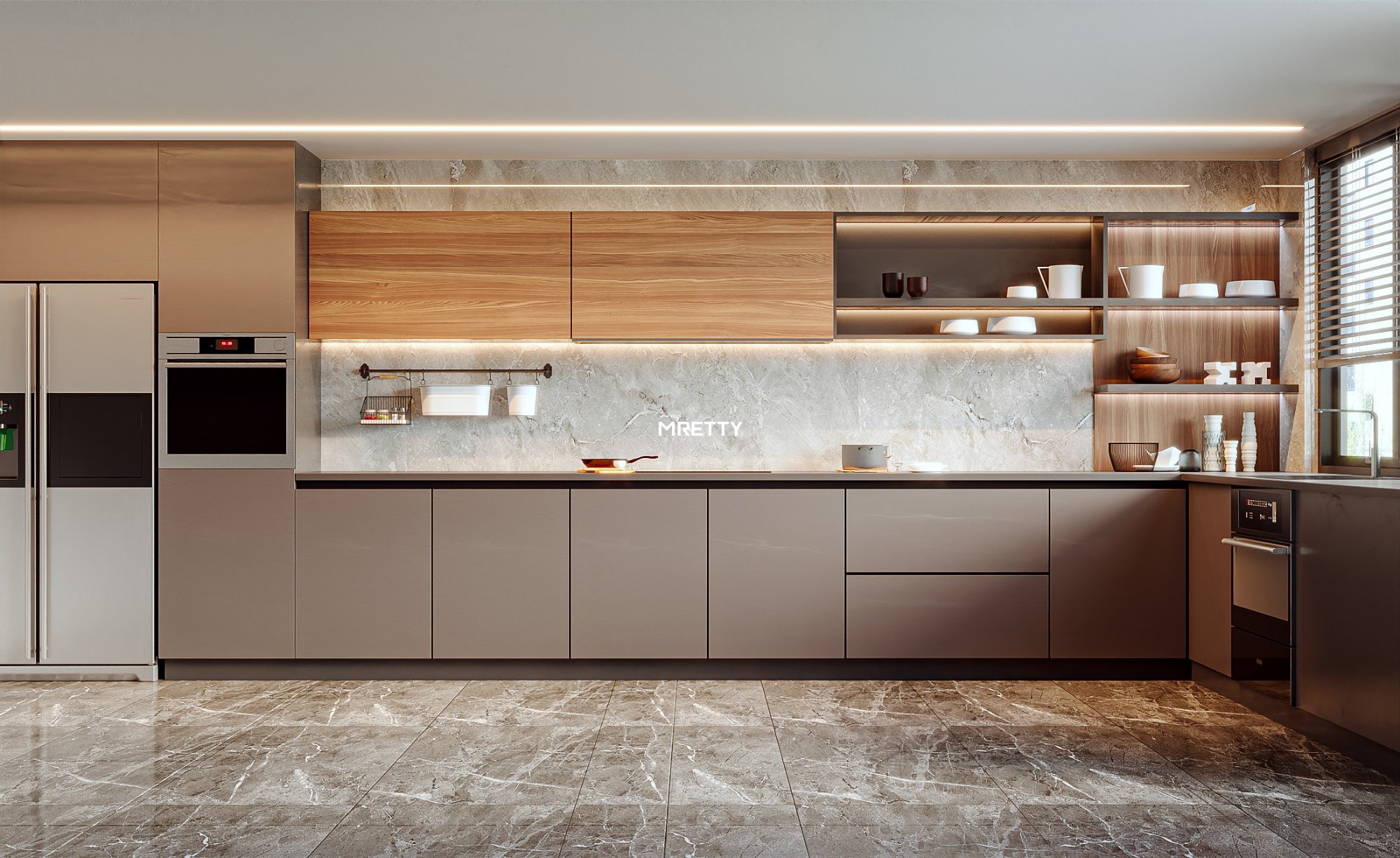
Prioritize durability and moisture resistance when selecting materials—vital for withstanding Singapore’s tropical climate and protecting your investment. While aesthetics matter, functionality and lifespan are paramount. I have seen visually stunning kitchens rendered unusable within two years due to poor material choices. For instance, our kitchen cabinets utilize high-moisture-resistant boards or E0-grade multi-ply plywood exclusively; we never use low-grade particleboard or MDF, which swell and warp upon moisture exposure. For countertops, marble offers beauty but is porous and prone to staining. For high-traffic kitchens, we recommend sintered stone or premium quartz. Hardware selection follows the same logic: premium hinges and drawer runners from brands like Blum prevent sagging doors over time. Such expertise is the hallmark of quality customization, saving you costly future repairs. Our showroom displays only materials proven resilient in local conditions—we have already filtered out unsuitable options.
Industry Insight: Currently, the most overrated material is limewash paint—visually striking on social media but difficult to apply, prone to chipping in high-traffic areas, and nearly impossible to patch seamlessly. The most underrated material is premium compact laminate. Often dismissed as cheap or dated, modern European imported laminates authentically replicate textures of fabric, leather, and stone. They outperform natural wood veneers in scratch and water resistance while costing a fraction of the price—a truly pragmatic choice.
Is Custom Carpentry Worthwhile for HDB Flats?
Absolutely. It is the most efficient method to maximize storage and functionality in HDB layouts. Off-the-shelf furniture often wastes space, whereas built-in wardrobes or TV consoles offer millimeter-perfect fits, increasing storage capacity by up to 30% compared to ready-made pieces. The seamless visual integration also creates an illusion of a larger living area.
❌ Common Pitfall: Following social media trends blindly. Viral materials may not suit high-traffic areas or local humidity.
✅ Better Approach: Discuss your lifestyle with your designer and select materials based on performance. Prioritize scratch-resistant, easy-clean finishes if you have young children. Opt for heat and stain-resistant countertops if you cook frequently.
Strategic material selection, rather than chasing fleeting trends, is key to creating a durable, value-retaining home.
Factory-Direct Customization: Where Quality Meets Value
The factory-direct model means your custom furniture is designed and manufactured by the same entity. This ensures superior quality control, optimized costs, and higher precision—the cornerstone of MRETTY’s operations. When designers, project managers, and production teams operate under one roof, communication gaps are minimized. Traditional models suffer from fragmentation: design firms outsource production to the cheapest third-party workshops, resulting in inconsistent material quality and craftsmanship. Our 15,000-square-meter smart factory eliminates outsourcing. CNC cutting machines achieve sub-millimeter accuracy, while automated edge-banding and finishing deliver consistency impossible to replicate manually across different workshops. This seamless link from design to production ensures the vision you approve is the reality you receive.
Avoiding Common Pitfalls to Protect Your Renovation Investment
Protecting your investment requires identifying risks early. Beyond budgeting and compliance, communication breakdowns and unclear expectations often derail projects.
- Vague Contracts: Ensure your contract includes a detailed scope of works, specifying material grades, brands, and exact dimensions. Ambiguity is the root of disputes.
- Lack of Milestones: Reputable firms provide a project schedule with key milestones, clarifying mutual responsibilities and managing expectations.
- Skipping Defect Checks: Never rush the handover. Inspect every detail—carpentry alignment, paint finish, socket placements. Reliable firms conduct formal defect rectification walks; we perform joint inspections with our clients to ensure accountability.
Staying proactive in these areas ensures a smoother process and safeguards the value of your custom interior design investment.
MRETTY: Premium Bespoke Kitchen & Cabinet Systems Provider in Singapore.
