
 Singapore
 China
China
TL;DR:
When hunting for a renovation partner in Singapore, don't be seduced by surface-level pricing. What you need is a specialist who seamlessly integrates design, production, and installation under one roof. This guide walks you through 5 essential steps: verifying HDB licensing and CaseTrust accreditation, understanding the differences between service models, spotting quotation traps, and ultimately finding a top-tier Singapore renovation company like MRETTY — one with its own factory and the capability to deliver true whole-home bespoke solutions. The payoff? Predictable results, zero timeline excuses, and a budget that stays exactly where it should.
One-Line Summary:
Choosing the right renovation company in Singapore comes down to scrutinising comprehensive strength — not just flashing an HDB licence. The winning formula: verify credentials, distinguish service models (contractor vs ID firm vs whole-home custom), read portfolios and reviews correctly, and dissect the quotation to kill hidden-cost traps before they hatch. Most importantly — confirm the company runs its own smart factory, the way MRETTY does. That is the ultimate insurance policy on quality and delivery.
Choosing a renovation company is like casting the director for your home. You are not looking for a foreman who just takes orders — you need a partner who gets your vision, protects your budget, and actually delivers the finished work at the standard promised. In Singapore, this choice carries extra weight. It shapes how you live in that space for the next ten years.
As a Whole-Home Designer at MRETTY with 14 years in the trenches of this industry — from bare-bones BTOs to Sentosa penthouses, hundreds of projects deep — I have seen where homeowners go wrong at step one. They fall in love with styled mood boards and glossy 3D renders, while ignoring the actual bedrock that makes any of it real: a reliable team and a production workflow they can actually control. This article is the methodology I wish every homeowner had before signing anything.
1. Verify Credentials: Beyond the Basic HDB Licence Check
In Singapore, confirming that a company holds a valid HDB Renovation Licence is absolute table stakes. It legally entitles them to carry out works in HDB flats. You can verify this directly on the HDB website's "Licensed Renovators" directory by company name or licence number.
But here is the part most people miss: the licence is only the starting line, not the finish line.
A far more meaningful credential is CaseTrust accreditation, issued by the Consumers Association of Singapore (CASE). CaseTrust audits pricing transparency, clear allocation of responsibilities, proper deposit protection, and dispute-resolution frameworks. As of 2026, CaseTrust-accredited renovation firms remain a minority — which makes it a powerful filter by itself.
Last year, Q3, I took over a resale flat project in Tampines where the previous firm had an HDB licence but subcontracted the carpentry twice removed. The result? Wrong cabinet dimensions, repeated rework, the timeline dragged nearly five months past schedule, and the budget blew out by almost 20%. The lesson landed hard: a licence proves someone can step onto the site, not that they can deliver it right.
❌ Common Myth: "If they have an HDB licence, they are safe enough," while ignoring commercial track record and project management history.
✅ Smarter Move: Beyond the HDB licence, run the company UEN through ACRA (Accounting and Corporate Regulatory Authority) to check incorporation date and financial standing. Then prioritise firms carrying CaseTrust accreditation. Think of the HDB licence as the admission ticket; CaseTrust and a long, clean trading history are the VIP badge that filters out the unstable players.
2. Know Your Service Models: Contractors, ID Firms & Whole-Home Customisation
A lot of homeowners use "Interior Designer (ID)" and "Contractor" interchangeably and vaguely. Then there is a third, more integrated model — the whole-home customisation company, the kind MRETTY represents. Knowing which one you are actually hiring changes everything.
| Service Model | Pros | Cons |
| :--- | :--- | :--- |
| Contractor | Usually the lowest price. Good if you already have complete drawings and know exactly what you want. | Provides zero design or project coordination. You manage all trades yourself. End quality depends heavily on one person's craftsmanship. |
| Interior Design (ID) Firm | Handles space planning, design, and project management — saves you from coordinating chaos. | Most ID firms have no factory of their own. Carpentry is outsourced. That creates uncontrollable risks in quality, lead time, and communication gaps. |
| MRETTY Whole-Home Custom | Design → Production → Installation, all in-house. Own smart factory guarantees millimetre-level precision and predictable schedules. | Requires deeper upfront communication — you need to articulate habits and lifestyle clearly — but the long-term payoff is massive. |
Here is the myth worth killing: "Bigger, more famous ID firm = safer bet."
The reality? Real security comes from integration, not Instagram followers. A large ID firm that outsources its core cabinetry, wardrobes, and carpentry to three different third-party workshops is essentially running a coordination exercise, not a controlled build. Delays cascade. Quality varies cabinet to cabinet. Blame gets shuffled between "the designer" and "the factory."
By contrast, a company — maybe not the loudest advertiser, but one running its own production line with a closed-loop design → build → install workflow — controls quality, cost, and timing at the source.
❌ Common Mistake: Assuming that hiring an ID firm means everything downstream is handled, without ever asking where the cabinets are actually made.
✅ The One Question to Ask: During the consultation, ask point-blank: "Are your cabinets and custom furniture produced in your own factory, or outsourced to a third party?" A company proud of its production capability will answer without hesitation — and will likely offer to show you the facility. One that hedges or deflects? That tells you everything.
Know whether you need an executor, a coordinator, or an end-to-end partner who owns the process from first sketch to final hinge. That clarity drives every right decision after it.
3. Decode Portfolios & Reviews: From Qanvast Ratings to Site Visits
A portfolio is a company's shopfront — but you need to learn how to look past the filter. Platforms like Qanvast and HomeRenoGuru are solid starting points for browsing Singapore renovation company reviews and past projects. Just don't stop at scrolling pretty pictures.
I tell clients: grab a magnifying glass for the details. In those photos — are the cabinet gaps consistent? Do different material junctions (stone to laminate, wall to ceiling) meet cleanly, with invisible or beautifully executed trims? Is the project only shown as a vacant, staged "showroom" shot, or are there images reflecting real life — stuff in the cabinets, lived-in textures? Those unglamorous details reveal the actual discipline of the build.
Take a BTO project we completed along Waterway @ Punggol last year. On Qanvast you will not just find the hero living-area shot — we uploaded close-ups of the wardrobe's internal hanging zones, drawer compartmentalisation, even the Austrian Blum hinge mechanism in macro. That is the proof of workmanship.
Here is a counter-intuitive tip: I would rather you see feedback from a project that has been lived in for 2–3 years than admire a freshly handed-over unit. Time is the only honest inspector. Any hardware corrode? Any door sag? These are what determine whether the renovation actually lasts.
For Singapore condo renovations or landed luxury projects — the tier where high-end interior design lives — physical verification matters even more. If possible, request a visit to an active worksite. Is the site orderly? Are materials stored cleanly off the floor? Are tradespeople organised? A chaotic site cannot birth a precise finish.
❌ Common Mistake: Getting hypnotised by professionally photographed, heavily styled "after" photos while missing workmanship consistency and long-term durability.
✅ Smarter Move: Ask for multi-angle shots of the same project, including internal structures and trim/joint close-ups. Push for a visit to an active site if you can. Real work speaks; polished marketing images just pose.
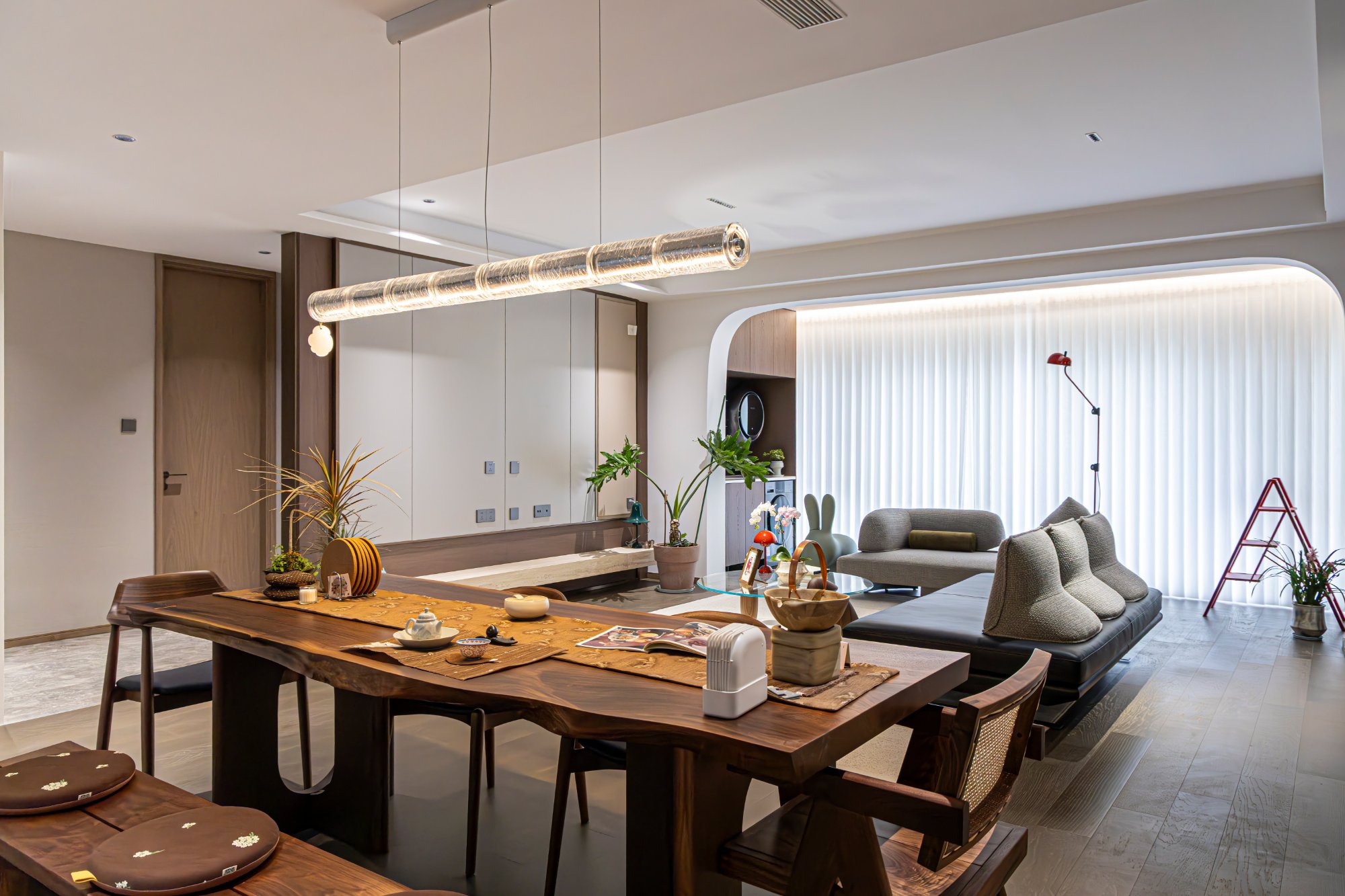
4. Dissect the Quotation: Spotting the "Lowball-Then-Upsell" Financial Trap
The quotation is where most traps hide. A rock-bottom Singapore renovation quotation comparison almost always conceals a trail of "variation orders" waiting to ambush you later. A proper quotation should read like a technical specification sheet, not a vague menu.
How do you tell the difference? Granularity. Compare these two:
-
Vague Quote:
Living Room TV Feature Wall: $2,500 -
MRETTY Detailed Quote:
Living Room TV Feature Wall (Dimensions: 3000mm × 400mm × 450mm): $3,800
- Carcass: MRETTY E0-grade engineered board (Finish: Smoked Oak) - Door/Face: Italy-imported FENIX® NTM® nano-tech matte panel (Colour: 0720 Nero Ingo) - Hardware: Austrian BLUM® LEGABOX tandem box drawers × 3 sets - Handle: Recessed integrated handle (45° chamfered edge profile) - Includes: Transport, installation & 10-year warranty
See the difference? The second version makes every dollar traceable. When a quotation leans on fuzzy line items like "Misc. works – 1 lot" or "Carpentry – 1 item", those are open backdoors for future "extras" to walk through.
A company confident enough to offer a fixed-price contract is essentially putting its own margin on the line — betting that its project management and supply chain are tight enough that they know what the job actually costs. Because MRETTY owns the factory, our board and hardware costs are controlled at the source. We know exactly what a project requires before we cut a single panel, which is why we can lock the price and mean it.
❌ Common Mistake: Shopping purely on the bottom-line total, picking the cheapest number, then getting hit with "upgrade this" and "we didn't include that" surcharges every week once works start.
✅ Smarter Move: Insist every quote break down to brand, specification, dimension, quantity, and described workmanship. Line up those detailed schedules side by side so you are comparing apples to apples — same material grade, same scope, same warranty.
A transparent quotation is not just business integrity on paper. It is the technical blueprint that keeps your project from unraveling.
Curious about MRETTY's integrated whole-home customisation workflow?
Tired of juggling three different vendors and praying the final result matches the render? Download our free case collection and see exactly how we delivered a dream home for a Punggol BTO owner — design, production, and installation, all under one roof — balancing high aesthetics with brutalist-efficient storage.
[➡️ Download MRETTY 5-Room BTO Whole-Home Customisation Case Collection]
5. Probe Core Capability: Why an In-House Smart Factory Is the Lifeline of Quality
This is the point I consider most important — and the one most homeowners never think to ask. A renovation company's ceiling is not set by how famous its designers are. It is set by how well it can actually build.
The vast majority of Singapore ID firms run on outsourcing: design drawings get emailed to a third-party carpentry workshop. That model creates three chronic problems:
- Quality drift: Different workshops = different machines, different skill levels, different material grades. No two cabinets age the same.
- Timeline fragility: Your project is one job among dozens in someone else's queue. Communication lags. Coordination breaks.
- Finger-pointing: When something goes wrong, the design firm blames the factory, and the factory blames the drawings. You sit in the middle.
Contrast that with a company like MRETTY. Our backbone is a S$10M+ investment, 15,000 m² owned smart factory. Here is what that actually means for your home:
When a designer finalises a whole-home custom layout for a compact Singapore apartment, the data goes straight from the design terminal to our German HOMAG production line. Our laser-edge banding technology fuses edge tape into the board substrate so seamlessly the joint is virtually invisible — which means moisture cannot penetrate the core. In Singapore's humid climate, that is the difference between cabinets that stay razor-sharp for ten years and ones that swell, delaminate, and fail inside 18 months. Machine tolerance hits 0.1 mm — precision no manual workshop can replicate.
Then there is material integrity. We control sourcing at the origin, guaranteeing all boards meet European E0 emission standards — formaldehyde levels far below what typical off-the-shelf boards deliver — critical for households with kids or anyone chemically sensitive. And we bulk-spec and test premium imported hardware like Austria's Blum — hinges cycle-tested to 200,000 openings, which at 10 open/closes a day gives you 50+ years of service life.
❌ Common Mistake: Assuming a beautiful 3D render guarantees a beautiful reality, without asking who physically builds it and on what equipment.
✅ Smarter Move: Straight-up ask — and verify — whether the company owns its production facility. When you visit the showroom, inspect sample joints, edge-banding seams, and hardware feel. Those tactile details are the truth-tellers of production muscle.
Choosing a firm with serious back-end manufacturing firepower is, fundamentally, buying insurance on your home's long-term quality and daily usability.
Renovation Guides by Popular Singapore Property Types
Different housing types demand different strategic priorities. As an experienced Singapore BTO renovation specialist and condo renovation partner, here is what each type calls for:
The Post-Key-Collection BTO Renovation Timeline
Once you collect keys for a new BTO, the typical sequence runs:
- Defect Inspection (DI): Log all HDB-reported defects and get them rectified first.
- Finalise Design & Scope: Lock all details with your renovation partner.
- Apply for Renovation Permit: Your firm handles the HDB permit submission.
- Base Works Begin: Hacking (if any), electrical, plumbing, tiling.
- Custom Furniture Installation: Factory-built cabinetry delivered and assembled on-site.
- Finishing: Final paint, touch-ups, deep clean, and handover inspection.
For a typical 4-room unit (~90 m²), the full run normally takes 8–12 weeks. The leverage point is front-loaded space planning — squeezing maximum utility out of the fixed footprint before a single tool touches the wall.
Choosing Eco-Safe Materials for Families with Children (Singapore)
Parents rightly set the bar highest on health. Do not just take a salesperson's word — ask for test certificates. Prioritise E0-grade or F★★★★ (F4-star) boards for formaldehyde control. And favour water-based paints over solvent-heavy alternatives for lower VOCs. MRETTY's whole-home customisation defaults to E0-grade boards precisely to protect indoor air quality at the source — because a beautiful home means nothing if it does not feel safe to breathe in.
Luxury Renovation & Design for Large Condos / Landed Homes
For large condos, penthouses, and landed properties, the brief shifts from "how do I fit everything in?" to "what atmosphere am I building, and how does the home express my lifestyle?" This is where integrated smart-home infrastructure, layered lighting design, and premium material intersections come into play. One recent Orchard Road apartment we delivered paired full-height natural marble feature walls with MRETTY's custom matte-lacquer cabinetry — material contrast (stone vs silent matte) doing the heavy lifting for an understated luxury feel.
Whether you are a first-time BTO owner or a luxury condo dweller after high-end customisation, the only viable success path is a partner whose process is transparent and whose output they actually control.
Frequently Asked Questions (FAQ)
How much does it cost to renovate a 4-room HDB flat in Singapore?
Based on 2026 market conditions, a full renovation for a new 4-room BTO (~90 m²) at mid-range quality typically lands between roughly S$50,000 – S$75,000. That covers design, base works (electrical/plumbing/tiling/painting), full custom cabinetry (kitchen + wardrobes + storage), and all associated coordination. A resale flat often runs 20%–40% higher because of hacking, rewiring, and potential tile or toilet overhauls. Final cost moves with material grade, custom scope, and structural changes.
How do I verify a Singapore renovation company's credentials?
Three-step verification:
- HDB Licence: Search the company name or licence number on HDB's "Licensed Renovators" directory. Confirm it is active with no suspension record.
- ACRA Check: Look up the UEN on ACRA to see incorporation date and entity background. Firms operating 5+ years tend to be materially more stable.
- CaseTrust Accreditation: Prioritise this. It signals audited deposit protection, transparent pricing, and clearer dispute handling.
What is the difference between an Interior Designer (ID) and a Contractor in Singapore?
Contractors are executors — they build to your provided drawings; you coordinate everything. Interior Designers (IDs) are coordinators-creatives — they provide space planning, design development, and manage trades so you don't have to. Whole-home customisation companies like MRETTY go one layer deeper than the typical ID: they also own the production engine, closing the loop so design intent is not lost in translation at a third-party workshop.
What are the main traps to avoid in Singapore renovations?
The big three:
- The Loss-Leader Quote: Dangerously low bids that blossom into a garden of variation-order surcharges once works start.
- Vague Contracts: Loosely described material brands/specs letting the firm swap in inferior substitutes without technically "breaking" anything.
- Outsourcing Risk: Core carpentry handed to unknown third-party factories, creating quality roulette and timeline excuses. The antidote: fixed-price contracts with detailed specifications, and a partner that owns its production.
About the Author
!placeholderforauthorimage.jpg
Hanson — Whole-Home Designer, MRETTY
With 14 years of specialised experience in Singapore's high-end kitchen and custom cabinetry system design and project management, Hanson is obsessed with the intersection of aesthetics, ergonomics, and production discipline. He works primarily with Condominium and Landed Property owners, shaping spaces in Modern Minimalist, Italian Quiet-Luxury, and French Classical vocabularies — always with the conviction that great design is not just what you see in the render, but what you can guarantee in the build. At MRETTY, the design → factory → install integration model is exactly what allows him to deliver on that standard, project after project.
MRETTY: Premium Bespoke Kitchen & Cabinet Systems Provider in Singapore.
