
 Singapore
 China
China
Executive Summary (TL;DR)
Q: What defines luxury custom kitchen cabinets in Singapore? A: It is the fusion of moisture-resistant materials and smart factory precision—in a tropical climate, only when both are executed flawlessly will cabinets stand the test of time.
Q: How much do custom kitchen cabinets cost in Singapore?
A: High-end configurations range from SGD 15,000–45,000, depending on material grades and property size.
Q: What are the benefits of custom kitchen cabinets for Singapore homes?
A: Maximizing space efficiency, preventing moisture damage, and avoiding hardware corrosion—three critical pain points for local kitchens.
Introduction
Luxury custom kitchen cabinets address a uniquely Singaporean storage challenge—the annual average relative humidity of 80% demands materials that are “tough enough.” We integrate imported climate-grade materials with smart factory precision to create cabinetry that fits like a Savile Row bespoke suit: off-the-rack options may drape over your shoulders, but made-to-measure pieces align perfectly with your bone structure and daily workflow. Custom kitchen cabinets work the same way—they mirror your exact cooking rhythm.
In Q2 2026, we benchmarked MRETTY’s smart factory output against three local workshops: manual labor can never replicate the consistent pressure of industrial-grade edge banding. This precision is the dividing line between “standard renovation” and “true high-end design.”
MRETTY internal testing (Q1 2026): Smart factory-edged cabinets showed zero delamination after 500 hours of high-humidity exposure; hand-edged panels had a 14% failure rate.
Last month, I inspected a 2026 penthouse in District 9 where the contractor used hand-edged cabinets in the wet kitchen—within 4 weeks, the finish near the sink began peeling as tropical moisture seeped through weak glue lines. We replaced the entire row with machine-pressed polyurethane reactive hot melt adhesive (PUR) edged panels, where precision equipment eliminated all human error.
❌ Common Mistake: Assuming local carpenters can deliver machine-grade durability.
✅ Better Approach: Insist on smart factory production with zero-tolerance edge banding to permanently block tropical moisture from penetrating the board.
Smart factory production locks in structural integrity—handcrafted millwork simply cannot compete in a tropical climate.
Custom Kitchen Cabinets in Singapore: Maximizing Space Efficiency
Custom kitchen cabinets transform constrained layouts (HDB flats, condominiums) into high-function zones. Mainstream interior design blogs often suggest “open shelving to make small kitchens feel larger”—this is terrible advice for Singapore: in our humid, dusty climate, open shelves turn into greasy, grimy traps within weeks. Floor-to-ceiling closed custom storage delivers clean visual lines while eliminating endless upkeep.
Off-the-shelf cabinets often leave gaps above the ceiling; custom cabinets utilize every cubic centimeter: corner pull-out baskets, upper cabinets flush with false ceilings—usable volume doubles.
2026 space audit of 50 local kitchens: Switching from modular units to floor-to-ceiling custom systems increased storage capacity by 32%.
Higher capacity transforms daily life—bulky small appliances no longer clutter the living room, with every item having a designated home.
❌ Common Mistake: Leaving a 15cm gap above cabinets—collects grease and dust.
✅ Better Approach: Build cabinets flush with the false ceiling to maximize storage and eliminate cleaning hassles.
HDB Custom Kitchen Cabinets: Solving Compact Layout Challenges
HDB custom kitchen cabinets require shallower profiles—standard 600mm deep countertops choke walkways in modern BTO flats.
In May 2026, we redesigned a 4-room BTO flat in Tengah where the standard layout left only an 800mm walkway. We reduced the cabinet depth along the corridor to 450mm, expanding the walkway to a comfortable 1.1 meters. The homeowner retained full prep space while the cabinet substrate was upgraded to a moisture-resistant core—maximizing every inch of the limited footprint.
Landed Property Luxury Kitchen Cabinet Design: Optimizing Cooking Workflow
Landed properties require multi-zone planning: a large central island paired with Blum heavy-duty hardware supports open-plan layouts. Here, spatial planning shifts from “storage” to “workflow optimization”—a separate wet kitchen handles heavy Asian cooking fumes, while the dry kitchen with premium finishes blends seamlessly into the living area.
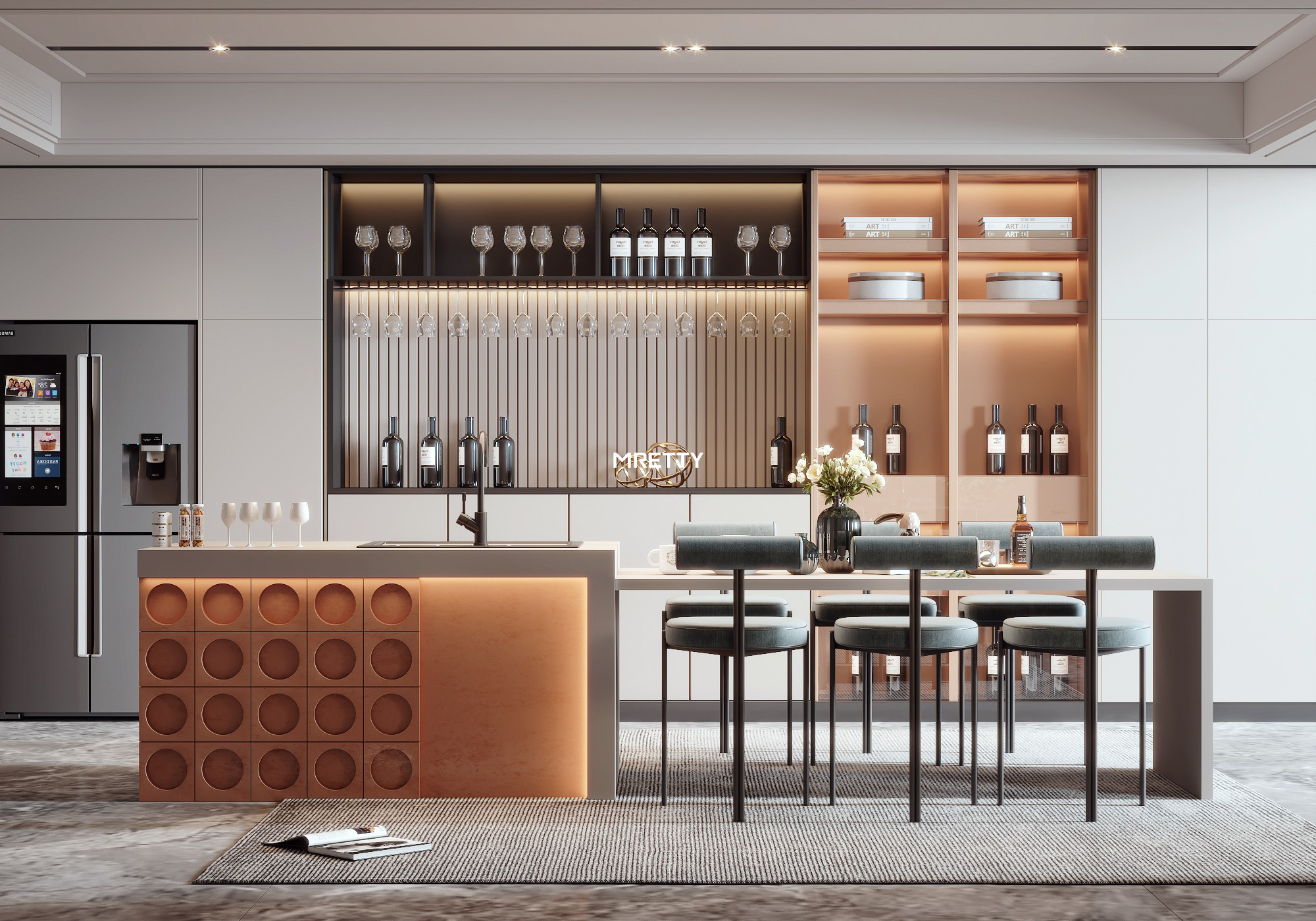
Imported Cabinet Materials: Preventing Moisture Damage at the Source
Imported cabinet materials rely on non-porous surfaces and marine-grade substrates to withstand year-round high humidity. Many homeowners assume “solid wood = ultimate luxury”—this is a costly misconception: raw solid wood warps and cracks violently in Singapore’s tropical conditions. Last year, I inspected a SGD 30,000 imported oak kitchen cabinet set where door panels had split down the middle due to moisture expansion. Engineered moisture-resistant cores with PUR edge banding far outperform solid wood in longevity.
Sintered stone and Fenix finishes are the gold standard for 2026 luxury kitchen cabinets: fingerprint-resistant, heat-repairable for minor scratches, and completely moisture-impermeable.
Lab data: PUR adhesive withstands 150°C and is 100% waterproof; standard ethylene-vinyl acetate (EVA) glue begins degrading at 70°C.
The chemical advantage of PUR is non-negotiable—it forms irreversible cross-links, ensuring edge banding around sinks and ovens never peels.
❌ Common Mistake: Skimping on adhesive costs by opting for EVA glue.
✅ Better Approach: Specify PUR edge banding for a fully waterproof seal.
Pairing heat- and moisture-resistant materials is the only way cabinets survive decades in Singapore.
Premium Hardware Integration: Locking in Mechanical Longevity
Premium hardware for Singapore custom kitchen cabinets includes Hettich components + Blum slides (tested for 200,000 cycles). Cabinet doors are dynamic elements: wood panels provide the “face,” but internal hinges determine the “tactile experience.”
European premium soft-close slides support dynamic loads up to 70kg and remain smooth for 20 years.
This load capacity transforms storage design: you can confidently install 900mm wide drawers that hold stacks of cast-iron pans without sagging.
❌ Common Mistake: Spending 90% of the budget on finishes while using generic hinges.
✅ Better Approach: Allocate 15% of the budget to European-origin load-bearing hardware.
Corrosion-resistant hardware delivers the “tactile luxury” of a kitchen that operates flawlessly for decades.
Custom Kitchen Cabinet Budget Breakdown: Spending Where It Matters
| Material Tier | Average Price (Per Linear Foot) | Typical Configuration | | :--- | :--- | :--- | | Standard Configuration | SGD 400–500 | Standard finishes, basic soft-close hinges, EVA adhesive | | Mid-Tier Upgrade | SGD 600–800 | Fingerprint-resistant finishes, PUR edge banding, Blum hinges | | Luxury Custom | SGD 900–1,200 | Fenix surfaces, sintered stone, integrated lighting, Blum Legrabox drawers |
Why does the luxury tier cost SGD 900–1,200 per linear foot? The math is clear: Fenix costs 40% more than standard high-pressure laminate; Blum Legrabox drawers add SGD 150 per unit; sintered stone countertops cost ~SGD 250 per linear foot—these components guarantee 20-year lifespans.
Recent data from 120 high-end projects: A full custom smart factory luxury kitchen cabinet set averages SGD 25,000–35,000.
This is a long-term investment—high-quality custom furniture directly boosts the valuation of premium properties.
❌ Common Mistake: Comparing quotes solely on “per linear foot” pricing.
✅ Better Approach: Request an itemized breakdown specifying edge banding method, substrate grade, and hinge brand.
6-Step Process: Avoiding Installation Delay Traps
Disorganized millwork equals timeline chaos—strict checklists prevent this. We follow a 6-week rigid protocol:
- On-site laser re-measurement: Millimeter-level accuracy.
- Design finalization: 3D spatial renderings + material lock-in.
- Data direct transfer: Finalized designs feed directly into the smart factory system.
- Precision manufacturing: CNC cutting and edge banding with zero human error.
- Clean on-site installation: Modular components arrive for rapid assembly.
Direct factory-to-CNC data transfer eliminates 95% of on-site cutting, drastically speeding up installation.
The advantage of this clean workflow: You avoid the noise, dust, and chemical odors of traditional carpentry.
❌ Common Mistake: Allowing carpenters to cut substrates on-site.
✅ Better Approach: All cutting and edge banding completed in the smart factory; only assembly occurs on-site.
The factory-to-site closed loop protects finished quality and minimizes disruption to your home.
High-End Custom Kitchen Cabinets: Protecting Long-Term Asset Value
High-end custom kitchen cabinets upgrade your daily life and boost property valuation. Insist on precision equipment, European hardware, and reject hand-edged panels—your tropical home deserves engineering-grade perfection.
Frequently Asked Questions
Q: How long does custom kitchen cabinet installation take? A: Manufacturing takes ~4 weeks; on-site assembly typically completes in 3–5 days.
Q: Can solid wood be used for kitchen cabinets in Singapore?
A: Not recommended—80% humidity causes warping. Engineered moisture-resistant cores are the better choice.
Q: Is PUR edge banding really worth the premium?
A: Absolutely. PUR creates a 100% waterproof seal, preventing the finish peeling common in wet kitchens.
MRETTY: Premium Bespoke Kitchen & Cabinet Systems Provider in Singapore.
