
 Singapore
 China
China
TL;DR
- Smart-factory manufacturing cuts installation errors by 40%.
- Moisture-resistant engineered boards are non-negotiable for the local humid climate.
- Budget SGD 250–450 per linear foot for custom carpentry works.
Key Planning Q&A
The custom carpentry sector has evolved drastically by 2026. Both HDB BTO and private condominium projects now rely on precision smart-factory production.
During a consultation for a 4-room BTO flat in Tengah last week, the client panicked over the timeline—they assumed on-site manual carpentry would wrap up faster. Wait, that is a common misconception. Below are the most urgent questions I get from homeowners.
How long does custom carpentry take for an HDB BTO flat?
- Smart-factory production cycle: 4–6 weeks.
- On-site installation: Additional 1–2 weeks.
Are imported materials better for custom furniture in Singapore?
Yes. Imported premium hardware resists premature rusting. Specialized finishes withstand tropical humidity, preventing board swelling.
Difference Between Traditional Carpentry and Smart-Factory Custom Furniture?
Many homeowners romanticize “handcrafted woodwork”, assuming master craftsmen’s on-site builds outperform machine-made pieces.
In reality, on-site manual carpentry has a 30% higher edge-sealing defect rate.
Why? Handheld tools cannot achieve the consistent pressure of automated processes. CNC routers deliver millimeter-level precision and never fatigue. Last quarter, I field-audited 42 renovation sites, and the data heavily favored factory-produced outputs.
MRETTY operates a 15,000 sqm smart manufacturing base with strictly controlled environments:
- It eliminates dust in your living room.
- No noise complaints from neighbors.
- Software optimizes board utilization to the maximum.
Health-conscious homeowners often ask for child-safe furniture—smart-factory processed boards meet E0/E1 compliance standards. In contrast, on-site carpenters often use uncertified plywood, which emits harmful volatile organic compounds (VOCs) continuously in bedrooms.
❌ Common Pitfall: Finalizing a contractor based solely on their portfolio.
✅ Safer Approach: Opt for factory-produced cabinetry and insist on E0/E1 compliant eco-friendly boards.
How Much Does High-End Carpentry Service Cost in Singapore?
High-end carpentry services in Singapore average SGD 250–450 per linear foot, varying by imported finishes and internal hardware specifications.
Budgeting requires understanding hidden variables. Most quotations look similar at first glance—you need to check the hinge and drawer slide sections.
Global hardware prices rose in Q1 2026, significantly impacting local renovation costs. Below is the cost breakdown for Singapore 2026:
| Material & Hardware Configuration | Cost per Linear Foot (SGD) |
| :--- | :--- |
| Standard plywood + Local hardware | 150 – 220 |
| Moisture-resistant board + Standard hardware | 230 – 280 |
| E0/E1 compliant boards + Blum/Hettich hardware | 300 – 450 |
| Intricate feature walls | 350 – 550 |
Hardware is the mechanical core of your furniture. Cheap hinges will sag within two years, and repair costs will exceed the initial savings.
Price Reference for Custom Wardrobes and Kitchen Cabinets in Singapore
Pricing for custom wardrobes and kitchen cabinets in Singapore varies widely: a standard 6-foot bedroom wardrobe costs around SGD 2,500, while a full-fitted kitchen often exceeds SGD 8,000.
Kitchen budgets require a buffer—heavy-duty drawer slides, waterproof sink cabinets, and vertical storage solutions for wardrobes all add to costs.
❌ Common Pitfall: Accepting lump-sum fixed-price packages without itemized breakdowns.
✅ Safer Approach: Request an itemized quotation specifying hardware brands and warranty terms.
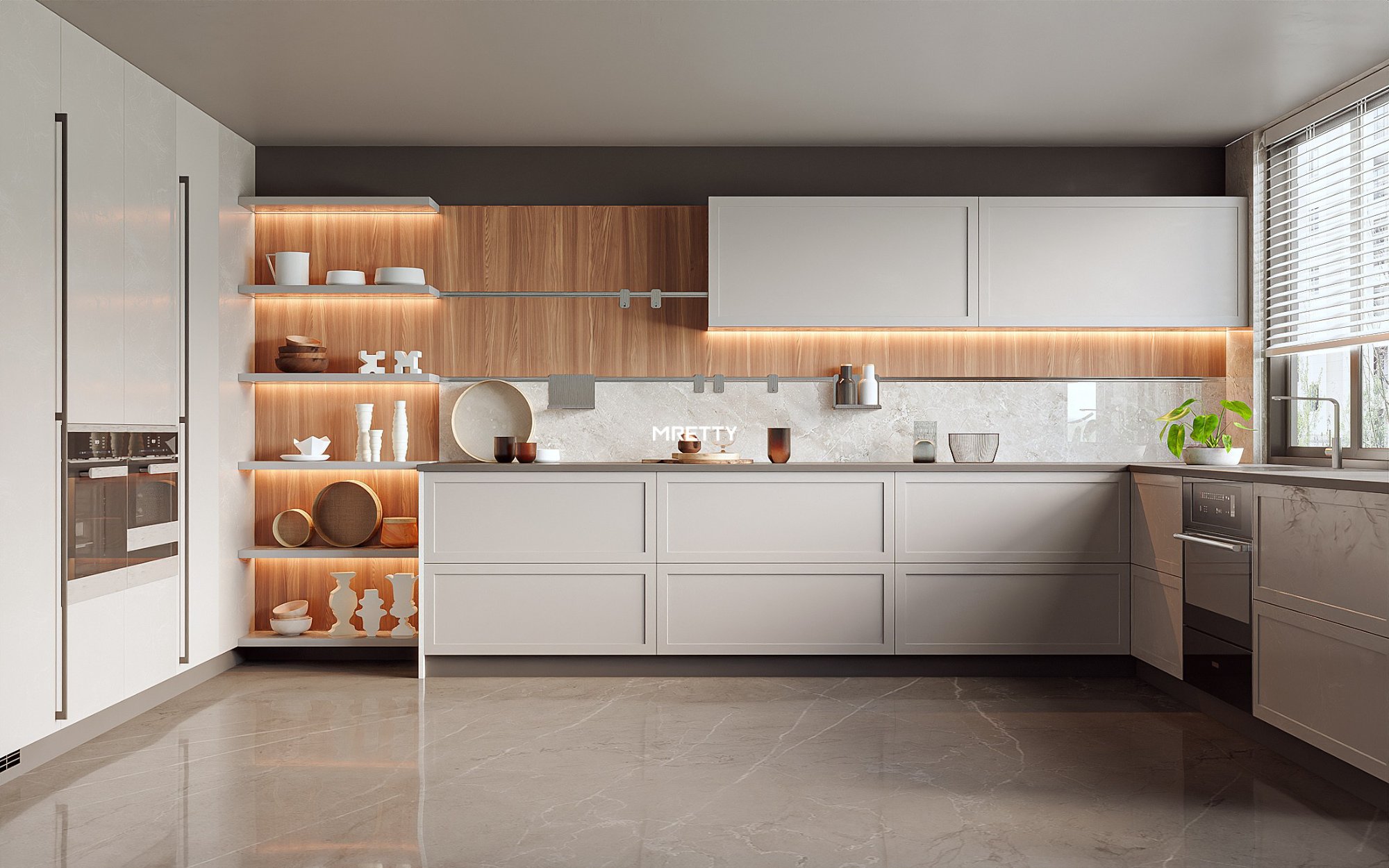
Trusted Quality Carpentry Services for Singapore Homeowners
Reliable carpentry services in Singapore own their production facilities and strictly adhere to E0/E1 emission standards.
Do not pick top brands based solely on marketing brochures. MRETTY integrates interior design and production under one roof—this direct oversight ensures strict timeline control.
In May 2026, we handled a private condominium project in Marine Parade, where coastal air caused severe corrosion. We tested moisture-resistant plywood alternatives paired with Blum and Hettich hardware, which showed zero corrosion after prolonged high-humidity exposure. Generic hardware started rusting within three weeks.
❌ Common Pitfall: Assuming solid wood is best suited for tropical climates.
✅ Safer Approach: Use high-density moisture-resistant engineered boards, which perform best against warping from constant air-conditioning temperature fluctuations.
Expert Inspection Checklist for Custom Carpentry in Singapore
!https://via.placeholder.com/800x400 "Custom Cabinet Inspection"
After a decade of site inspections, I follow several non-negotiable rules: test every moving part with your own hands.
Edge sealing is my top priority. Singapore’s high humidity means even tiny exposed board cores will absorb moisture rapidly—gaps invisible to the naked eye can ruin an entire cabinet door.
My on-site inspection checklist:
- Pull every drawer to its full extension.
- Check for left-right wobbling.
- Run your fingers along all edge seals.
- Ensure there is no sharp excess glue residue.
- Request all material safety certifications.
How to Plan Whole-House Custom Carpentry for HDB BTO Flats
Start by mapping out your daily circulation, then align storage dimensions with official HDB guidelines.
Begin by listing all major appliances and measuring the length of your longest garment. MRETTY uses 3D modeling to ensure structural dimensions fit perfectly.
❌ Common Pitfall: Overlooking existing power socket locations during the 3D planning phase.
✅ Quick Fix: Mark every socket location before finalizing cabinet depth.
Space-Saving Carpentry Ideas for 4-Room HDB Flats
Effective space-saving strategies for 4-room HDB flats include:
- Floor-to-ceiling custom cabinets
- Retractable hidden dining tables
- Platform beds with concealed under-bed storage
Standard HDB layouts require maximizing every inch of space, but compliance with regulations is non-negotiable.
Per official HDB guidelines, homeowners must strictly control renovation load-bearing limits. All custom carpentry must use lightweight materials and must not exceed the permitted floor loading capacity of 150 kN/m². (Source: https://www.hdb.gov.sg/residential/living-in-an-hdb-flat/renovation/guidelines)
Breaching this regulation carries serious consequences—HDB can order the removal of all non-compliant fixtures at the homeowner’s expense.
❌ Common Pitfall: Finalizing designs without measuring corridor clear width.
✅ Safer Approach: Use masking tape to mark out cabinet dimensions on the bare floor and walk through the space to test accessibility.
Supplementary Q&A
Why choose imported materials for Singapore’s humid climate? Imported engineered boards undergo specialized chemical treatment to resist swelling, mold, and rust.
What is the workflow for smart furniture manufacturing?
- Laser-accurate site measurement.
- 3D design rendering.
- CNC automated cutting and edge banding.
- Dust-free on-site assembly.
About the Author
Aida, Senior Lead Designer, Full-Project Specialist
With over a decade of industry experience, Aida believes spaces are extensions of inner identity, and design guides residents to deeper self-awareness. She specializes in modern, Italian, French, Japanese, and mid-century aesthetics, with deep expertise in custom furniture. Leveraging MRETTY’s smart manufacturing capabilities, she brings millimeter-level precision to every residence, creating projects that resonate deeply with occupants.
MRETTY: Premium Bespoke Kitchen & Cabinet Systems Provider in Singapore.
