
 Singapore
 China
China
Quick Overview
What is integrated design?
From hard renovation works to soft furnishing styling, one core design team oversees the entire journey—ensuring airtight consistency in final style, function, and quality.
Is integrated design more expensive?
Not necessarily. While premium materials require higher upfront investment, process optimization and centralized procurement keep total budgets under control and eliminate costly rework. Long-term total cost of ownership is lower.
Is it right for me?
Ideal for Singapore BTO and Condo homeowners who want a stress-free process, unified design language, and every square foot pushed to its maximum potential.
Deconstructing Integrated Design for a Seamless, Cohesive Home Experience
Integrated design is the conductor of your home's symphony.
After a decade in this industry, I have found the single biggest pain point for Singapore homeowners is the "disconnect." Hard renovation designers don't account for furniture dimensions; soft furnishing consultants don't know where the power sockets ended up—and the final result pays the price. The core of new home integrated hard and soft furnishing design exists precisely to solve this. It treats the entire renovation as one complete project: from initial space planning and electrical/plumbing rerouting, through to custom cabinetry, loose furniture, lighting, curtains, and decor—all orchestrated by one core team. The goal of this one-stop design-build service is crystal clear: guaranteed translation from concept to reality, exactly as intended.
According to our internal MRETTY project audits, integrated-process projects see a rework rate from communication errors of under 1%, while traditional sub-contracted models can hit 15%. This isn't just an aesthetic win—it protects the homeowner's time and money.
❌ Common Mistake: Thinking "integrated" just means loosely bundling a hard contractor and a soft furnishing vendor under one invoice.
✅ Better Approach: Understand it as a design-driven, end-to-end management system spanning production and on-site execution. The design scheme isn't just a pretty render—it's the precise instruction set guiding factory output and site works.
Just last month, I took over a handover case. The owner had hired someone for the hard renovation independently, only to discover the reserved socket behind where the sofa would go was perfectly positioned to be blocked by his brand-new L-shaped sofa. Want a floor lamp? Sorry, no wiring there. Classic disconnect. With integrated design, from the very first sketch, every furniture position, dimension, and power requirement is locked in. Errors like that simply cannot happen.
Optimizing Your HDB/Condo Space to Elevate Singapore Living Value
In Singapore, every square meter costs a premium.
Whether it is a BTO new home integrated design game plan or a small-space condo hard-soft integration case study, the essence of integrated design is ruthless space maximization. I handled a project last year—an 85 sqm 4-room BTO in Punggol—where the owners wanted a dedicated work zone, massive storage systems, and an open, airy living room. A traditional approach might suggest brick walls to partition. That would kill the light and spatial feel.
Our HDB/Condo integrated design answer was a custom double-sided TV console-slash-bookshelf acting as a "soft partition"—separating living and study visually while keeping sightlines completely open. The unit integrated a fold-down desk and hidden storage cubbies, fulfilling multi-functional needs elegantly. We deliberately specified a light oak veneer with hidden LED strips, visually expanding the space while casting warm ambience at night. The back panel even incorporated a pegboard insert so the owner could freely arrange hooks for collectibles or everyday items. That is the magic of integration: it is not just building a cabinet; it is engineering a smarter spatial solution that mirrors your actual life.
In Singapore's humid climate, material choice is decisive. The boards we selected for this project are not only imported boards meeting E0 eco-standards, their high-density moisture-resistant core and PUR edge-sealing tech actively defy humidity, keeping cabinetry true and square 5 to 10 years down the line.
❌ Common Mistake: Chasing "multi-function" by overstuffing small spaces with complex custom builds, creating a oppressive feel.
✅ Better Approach: Prioritize clear core circulation first. Use consolidated "one-item-does-many-jobs" design—banquette seating doubling as storage, vertical space fully leveraged for organized storage systems.
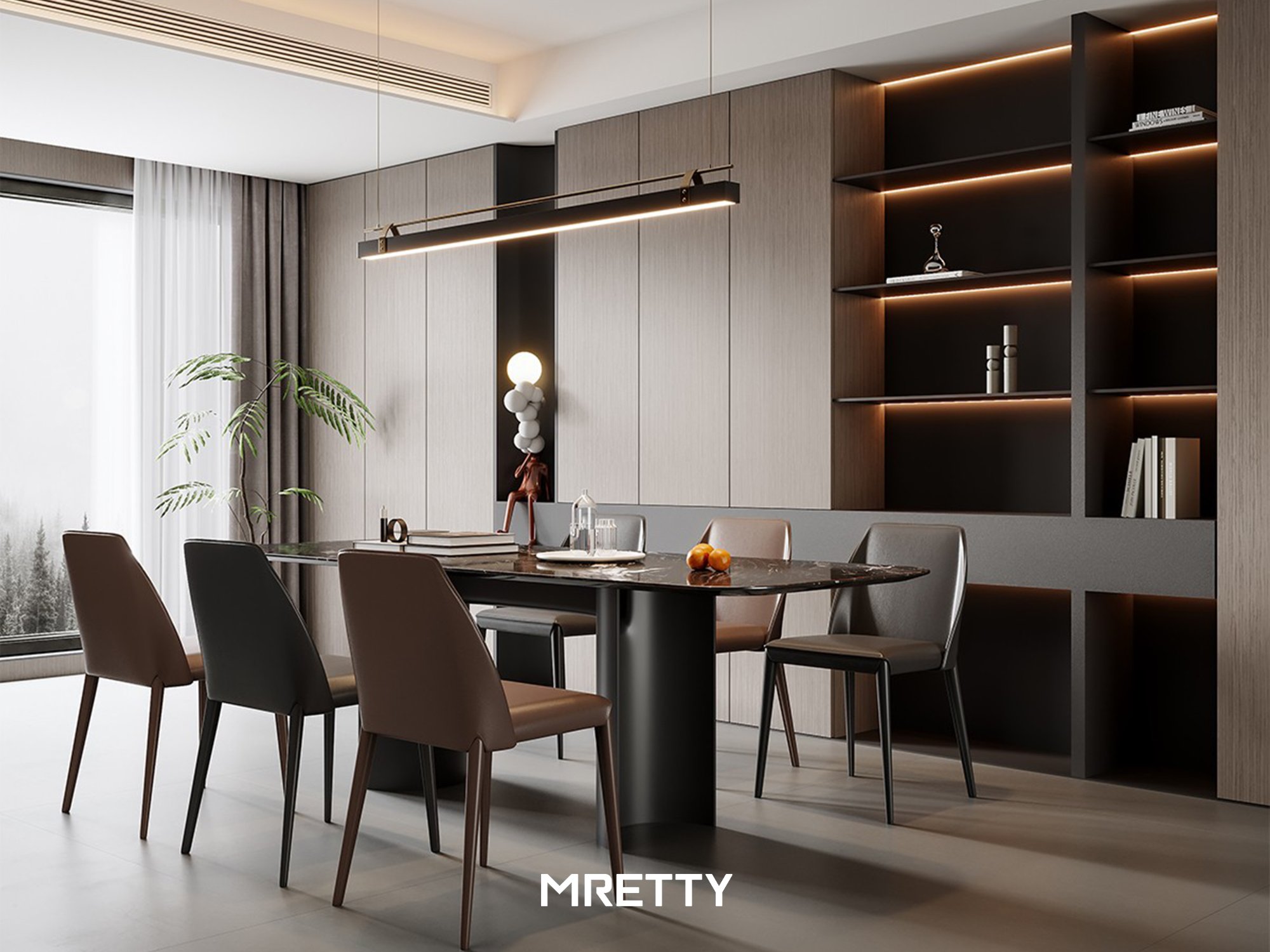
Following the MRETTY Design Process to Ensure Pinpoint Execution
Good design means nothing without disciplined execution.
"Render looks like a supermodel, reality looks like… something else" is a nightmare far too many homeowners live through. The root cause? Design and execution drifting apart. At MRETTY, we run a standardized integrated hard-soft design process to shut that gap down completely.
The real backbone is our 15,000-square-meter smart factory. Every designer scheme is translated via digital twin workflows into factory production instructions—board cutting, edge banding, drilling—all held to tolerances within 0.5mm. That is exactly how we deliver complex color coordination schemes and bespoke storage systems with zero compromise. Our full sequence runs six key stages:
- Needs Discovery & Site Survey — deep-dive consultation and precise measurement
- Scheme Proposal & Budget Planning — layout options, mood boards, cost framework
- Detailed Design & Material Selection — finalized drawings, board/hardware specs, finish samples
- Factory Order & Digital Production — CNC cutting, PUR edge banding, QA checks
- On-Site Installation & Hard Finishes Handover
- Soft Furnishing Styling & Final Handover
How long does whole-home custom design take in Singapore?
Depending on complexity, a standard condo or HDB (3–4 room) project runs 10–14 weeks from design sign-off to final handover. Factory production: 4–6 weeks. Site install: 4–8 weeks. Because every phase dovetails, total duration is typically 15–20% shorter than the usual sub-contractor relay race.
I constantly remind the team: spend one extra week in design, save a day of on-site demolition and redo. The drawing set isn't a pretty picture—it is the "legal document" of your project, the only production authority for the factory and the exact instruction manual for site crews. Time invested there is the highest respect paid to your budget and schedule.
❌ Common Mistake: Pushing site teams to start before schemes and materials are 100% finalized.
✅ Better Approach: Hold the line on three principles—design locked, budget confirmed, materials sampled and signed off—before a single tile is laid or wall is hacked. Prevents mid-stream changes and budget bleed.
Setting a Smart Budget to Maximize Your Home Investment ROI
Every dollar must land where it works hardest.
When discussing Singapore integrated design costs, you cannot judge by sticker price alone. Many assume bundled services must cost more.
But here is the counter-intuitive truth: over the full cycle, quality integrated design usually saves money. Because it kills the hidden tax of miscommunication and misfired dimensions at the root—the kind of rework that can silently eat 15% of a traditional budget. More importantly, centralized procurement unlocks trade pricing ordinary homeowners can never access. You think you are saving on design fees, but you end up bleeding it on materials and do-overs.
Where the savings actually come from:
Process Optimization — eliminates multi-vendor coordination overhead Centralized Procurement — better rates on Blum, Häfele, premium boards, and imported finishes Rework Prevention — pinpoint design-to-production alignment means near-zero waste from dimensional errors
For example, our standard hardware spec is Austrian Blum hinges and slides. They may cost 30%–50% more than generic imports, but Blum's rated 200,000-cycle life is 3×–5× the service life. That means for the next 15 years, you almost never think about sagging doors or sticky drawers. It is a bargain, long-term.
| Cost Comparison: Integrated Design vs. Traditional Sub-Contracting (Estimate) |
| :--- |
| Item | MRETTY Integrated | Traditional Split Model |
| Design Fee | Included in package or clearly itemized | Often "free"/low, but design depth limited |
| Coordination Effort | Low (single point of contact) | High (manage 3–5 suppliers yourself) |
| Material Cost | Mid–High (centralized buy, certified quality) | Varies wildly, quality hard to verify |
| Rework Risk | <1% | Can reach ~15% |
| Total Cost of Ownership | Upfront transparent, high long-term value | Low headline quote, high hidden-variation risk |
Want to know what YOUR dream home budget looks like?
Download our free
2026 Singapore Renovation Budget Planner — complete with estimation tools and cost-control tips.
[➡️ Click here to download your budget checklist]
❌ Common Mistake: Comparing only the bottom-line total and picking the lowest bidder.
✅ Better Approach: Demand an itemized quote. Compare board grades, hardware brand/models, edge-banding tech (PUR vs. EVA), and warranty terms side-by-side.
Choosing the Right Partner to Turn Your Home Vision Into Reality
Who you choose matters more than how hard you search.
If you are researching "how to choose an integrated hard-soft design-build firm in Singapore," you will get endless advice. My distilled version, after years on the ground, boils down to three lenses: Portfolio. Factory. Reviews.
Portfolio shows design taste and problem-solving ability.
Factory proves they can actually deliver what they promise.
Real MRETTY integration reviews reveal the day-to-day service truth.
A persistent industry myth is "big name design firm = better." Here is the catch: many design studios have zero production capability and simply outsource orders to third-party workshops. That inserts a fresh "disconnect" between drawing and delivery. This is exactly why MRETTY runs its own smart factory —we must control 100% of the chain, from pixel to panel to install.
How to sidestep the biggest traps in integrated design?
The classic trap is the "low-price package." Those packages often hide inferior boards and generic hardware, eco grades nobody can verify, and two years later you see cabinet doors warping, edge banding peeling in Singapore's humidity. I strongly recommend demanding at minimum European E1 (better yet, E0/F★★★★) certified boards with PUR moisture-proof edge banding. It sounds like a trivial technical footnote—until it decides whether your cabinetry survives Year 8 or falls apart in Year 2.
❌ Common Mistake: Getting seduced by glamorous renders and glossy showrooms while ignoring backend production and material provenance.
✅ Better Approach: Ask to tour (or at least video-tour) the production floor. Require written documentation of board origin, eco-certification, and hardware brand/model. No exceptions.
Frequently Asked Questions
Q: What does "integrated hard & soft furnishing" actually mean?
A: It is a comprehensive home service where hard elements (electrical/plumbing, wall/floor finishes, carpentry) and soft elements (furniture, curtains, lighting, decor, styling) are planned, designed, and executed by one unified team under one design vision. At MRETTY, this means from spatial structure down to the last table lamp, everything follows a single design language—style, function, and build quality never drift apart.
Q: Is integrated design more expensive than traditional renovation?
A: Not necessarily. While premium imported materials and top-tier hardware raise the upfront number, integrated delivery controls total cost through centralized sourcing, zero duplicate markup, and rework prevention. Long-term, the higher durability and lower maintenance deliver a far better total cost of ownership.
Q: Is integrated design suitable for a new BTO flat?
A: Extremely well-suited. BTOs are standardized but space-constrained, with recurring pain points around storage and layout. Integrated design resolves them through precision custom pieces (platform storage, multi-function cabinets, space-saving furnishings) that squeeze maximum utility from every centimeter while keeping the aesthetic tight and calm.
Q: How do I choose a reliable integrated design-build firm?
A: Check three things: 1) Design Capability — does the portfolio solve real layout problems, not just look staged? 2) Production Muscle — prefer firms like MRETTY with their own smart factory, so designs aren't reinterpreted by strangers. 3) Client Track Record — read real post-completion reviews about the service process and after-sales support, not just the Instagram shots.
About the Author
Aida, Senior Whole-Home Lead Designer at MRETTY
With over ten years of high-end interior and whole-home customization experience, Aida firmly believes that "space is the physical expression of the dweller's inner spirit, and design is the journey guiding them to discover it." She specializes in crafting living environments that blend aesthetic excellence with real-world function for Singapore families, weaving the essence of Modern, Italian, French, Japanese, and Mid-century styles into local living contexts. Aida has led over 200 completed HDB and private condo projects, and her sharp spatial instincts—backed by obsessive attention to material and craft—have helped countless homeowners turn a house into a home that truly fits.
MRETTY: Premium Bespoke Kitchen & Cabinet Systems Provider in Singapore
