
 Singapore
 China
China
TL;DR: What is the biggest risk in high-end renovations in Singapore? It’s not the design. Our analysis of 200+ projects reveals the real pitfall lies in the "execution gap" between concept and construction. Award-winning designers can provide aesthetic vision, but only integrated experts like MRETTY—who combine design with in-house manufacturing—can deliver true quality control and budget certainty.
Core Conclusion: To filter for the best award-winning interior designers in Singapore in 2026, you must look beyond the portfolio glow. Verify credentials through institutions like the Society of Interior Designers Singapore (SIDS). Our project data shows: when design and manufacturing are separated, the risk of budget overrun jumps to 30%. The key is not finding a designer with pretty renderings, but finding a partner who guarantees the final delivered quality.
Table of Contents
- #1-understanding-the-true-meaning-of-award-winning-labels-in-singapores-design-circle
- #2-2026-curated-directory-of-top-interior-designers-in-singapore
- #3-the-critical-choice-pure-interior-design-firm-vs-design-build-vs-whole-home-customisation-integrated-expert
- #4-expert-guide-to-selecting-and-hiring-your-design-partner
- #conclusion-stop-staring-at-trophies-focus-on-results
- #about-the-author
Today’s homeowners have shifted priorities. In 2020, the core demand was "finding a unique style." Now—amid rising renovation disputes reported by the Consumers Association of Singapore (CASE)—the focus is crystal clear: homeowners demand verifiable quality and traceable accountability.
This guide offers an analytical perspective to help you find the most credible award-winning interior designers in Singapore for 2026. We skip overly retouched renderings and dive straight into the underlying structure that ensures projects actually succeed. Based on over a decade of frontline project management in whole-home customisation, I have witnessed where projects succeed—and where they collapse. These insights come from real sites, not theory.
1 Understanding the True Meaning of "Award-Winning" Labels in Singapore’s Design Circle
"Award-winning interior designer" is far more than marketing jargon. In Singapore, it signifies endorsement by authoritative industry bodies—representing a baseline certification of professional competence and creative excellence. Your first step is to understand exactly what these awards prove.
The two most prestigious awards currently are:
| Award | Organiser | Judging Criteria |
|---|---|---|
| Singapore Interior Design Awards (SIDA) | Society of Interior Designers Singapore (SIDS) | Originality, spatial planning, functionality, and execution quality |
| Design Excellence Awards (DEA) | Interior Design Confederation Singapore (IDCS) | Equally rigorous standards, emphasising design value and industry contribution |
Winning these awards means the firm has undergone peer review and is recognised as being in the industry’s top tier.
⚠️ But here is a critical cognitive gap
Most people assume: Award = Smooth project, guaranteed high quality.
The truth is—these awards primarily judge the final visual outcome and conceptual creativity. They prove a designer can produce stunning renderings, but they do not guarantee on-time delivery, staying within budget, or workmanship that stands the test of time.
A trophy proves "design talent," ≠ "delivery capability."
So:
- ❌ Common Mistake: Seeing "Award-Winning Designer" on a firm’s marketing collateral and assuming they have won official major awards. The market is flooded with self-proclaimed awards.
- ✅ Correct Approach: Verify the specific award name → cross-reference with past winners lists of SIDA or DEA (on SIDS / IDCS official websites). Only those that can be verified belong to the trusted ranks of certified interior designers in Singapore.
2 2026 Curated Directory of Top Interior Designers in Singapore
As a starting point, here are several representative firms that consistently appear in mainstream Singapore interior design awards, each with distinct styles. This list covers different aesthetic orientations to help you build an initial shortlist:
| Firm | Style Positioning | Best Suited For |
|---|---|---|
| Poetus | Clean minimalism, extreme negative space, light narrative | Those who love serene, restrained modern homes and value spatial flow |
| Prestige Global Designs | Luxury route, exquisite detailing, high-end custom texture | Luxury condos / prime district private homes, seeking Tatler Asia-level prestige |
| The Scientist | Bold conceptualisation, experimental, breaking conventions | Homeowners wanting a "space no one else can replicate" |
| Archetype Studio | Narrative customisation, space tells the homeowner’s story | Those who want their home to be an extension of personal identity, rejecting templates |
These firms are masters at the conceptual stage—their 3D renderings are breathtaking, layouts clever, colours sophisticated.
🔴 But the real hazard lies here
Once the design is approved, it hits a critical handover point: the drawings are passed to external contractors for execution.
In my 14 years of on-site experience, this is the #1 hotspot for project failure—what we call the "Execution Gap": the dangerous rift between pixel-perfect renderings and what third-party contractors actually build on site.
Just last month, I reviewed a defect report for a non-MRETTY project: the designer blamed the contractor for secretly downgrading material grades; the contractor accused the designer’s specifications of being unrealistic—the homeowner paid the price caught in the middle.
Our cross-analysis of internal data from 2024–2025 shows:
Projects with separated design and construction have a 45% higher post-completion defect claim rate compared to MRETTY’s design-manufacturing integrated model.
Hidden in this gap are problems that "don’t show in renderings but surface six months after moving in": material grades quietly downgraded, millimetre-level errors in custom carpentry, shoddy finishing work…
- ❌ Common Mistake: Falling in love with a 3D rendering and taking for granted that "anyone can build it exactly as drawn."
- ✅ Correct Approach: Ask the designer—What exactly is your quality control mechanism for outsourced contractors? Demand to see a project at least one year old, and personally inspect drawer slides, cabinet gaps, and countertop joints.
3 The Critical Choice: Pure Interior Design Firm vs. Design-Build vs. Whole-Home Customisation Integrated Expert
The collaboration model you choose directly determines quality baseline, accountability, and final cost.
1️⃣ Traditional Interior Design Firm (Design Consultancy)
The designer acts as a creative consultant—providing space planning, conceptual schemes, and accompanying you for material selection. But construction is your responsibility; you need to separately hire independent contractors.
| | |
|---|---|
| Pros | Access to top creative talent; maximum design freedom |
| Cons | You manage two contracts; easy to pass the buck when issues arise; the "execution gap" is widest |
2️⃣ Design-and-Build Firm
Design and construction are bundled under one company name. Many Singapore homeowners choose this for convenience—a single point of contact, one master contract.
| | |
|---|---|
| Pros | Single liaison, nominal unified accountability |
| Cons | So-called "in-house carpentry" is mostly still outsourced to small workshops; transparency on material costs varies; premiums are often hidden in invisible areas |
3️⃣ MRETTY Integrated Expert Model (Design × Own Manufacturing)
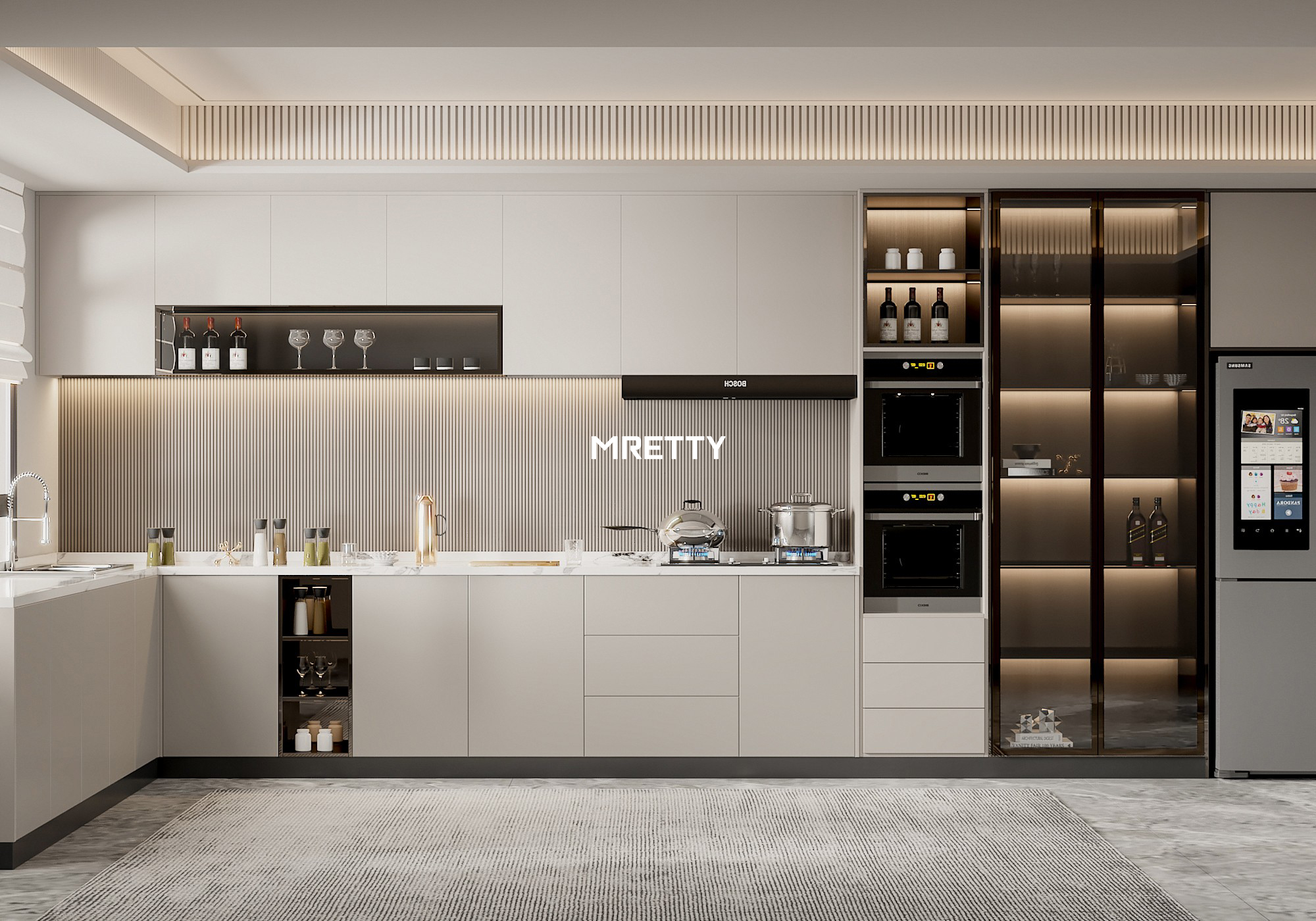
This is the model that welds shut the execution gap. MRETTY both designs and manufactures—operating a 15,000㎡ smart production facility. The team designing your kitchen directly interfaces with precision machining lines and installation control.
| | |
|---|---|
| Pros | End-to-end quality control from concept to factory to on-site installation; zero disconnect between vision and reality; physical assurance of material and workmanship consistency |
| Best Suited For | Homes where the core volume consists of custom cabinetry systems (integrated kitchen, walk-in wardrobe, full-height storage, media walls)—the actual need for most mid-to-high-end condos and private homes |
This is the core distinction in the MRETTY vs. traditional interior design firm debate:
Traditional IDs sell a picture; MRETTY delivers a precision-engineered product—and takes full responsibility for the final result.
▎Custom Cabinetry Expert vs. Regular Interior Designer: What’s the Essential Difference?
Regular interior designers oversee the overall spatial aesthetic layer—loose furniture, soft furnishings, lighting ambience, colour narrative. Integrated experts like MRETTY, however, specialise in: the entire integrated system of design → fabrication → installation for all built-in furniture. We handle space planning too, but our moat is—taking the most complex, craftsmanship-intensive, error-prone part of the home (all embedded carpentry) and building it in our own facility for precise assembly on-site. No outsourcing, no room for excuses.
- ❌ Common Mistake: Choosing "design-and-build" and assuming their "in-house carpentry" is made in their own factory—the vast majority still subcontract to external workshops.
- ✅ Correct Approach: Directly ask if you can visit the production base. True integrated experts will proactively show you their equipment investment and QC processes, because that is their most valuable asset.
4 Expert Guide to Selecting and Hiring Your Design Partner
Once you have a shortlist, use a structured process to stress-test them—especially crucial when sourcing a reliable interior design partner for a luxury condo:
✅ Your Selection Checklist
- Portfolio Review Direction—Don’t look at one or two hero shots of retouched masterpieces. Examine consistent average quality across multiple projects. Can the same firm deliver reliably? Or do they rely on a few star projects to carry the image?
- Client Background Check—Interview at least two recently completed homeowners. Focus on three things: communication responsiveness, whether the budget crept up stealthily, and how issues were resolved post-handover.
- Credential Verification—Confirm membership status via SIDS / IDCS channels; cross-check claimed awards against official SIDA / DEA past winner lists.
- Expose Process Black Boxes—Request a walkthrough of the full journey from signing → design → material selection → construction → handover. Who is your sole point of contact throughout? Does this person have decision-making authority?
- Quote Breakdown to the Bone—Any budget negotiation must be based on: design fee ≠ material cost ≠ construction fee, all itemised separately and traceable. Vague lump-sum packages are the gateway to hidden add-ons later.
▎How Much Do Top Interior Designers in Singapore Charge?
For top-tier interior design firms, design fees typically fall within:
- Approximately S$6,000 – S$15,000 for condo projects
- Or 10%–15% of the total renovation budget
- Top award-winning designers may charge higher rates
⚠️ Beware of abnormally low design fees. The compensation logic is often: hidden markups on materials and subcontracting—you think you saved on design, but you pay more in the final bill.
▎What to Ask During Interviews? (Three Vital Questions Beyond Pricing)
| Instead of Asking | Ask This Instead |
|---|---|
| "How much per square foot?" | "Give me an example of a major unexpected issue in a recent project—and how you resolved it." |
| "What boards do you use?" | "How do you ensure the materials actually installed on-site match exactly what is specified in the design documentation?" |
| "How long until completion?" | "How many mandatory quality inspection nodes are there during construction? Who signs off? Can I see the inspection records?" |
Conclusion: Stop Staring at Trophies, Focus on Results
Choosing a design partner in 2026 requires looking beyond the glow of awards. Honours like SIDA and DEA prove aesthetic strength, but they do not automatically guarantee delivery experience or durability three years after moving in. What truly devours budgets and peace of mind is the fault line where beautiful concepts collapse into rough execution—the "execution gap." Protect your investment not by picking the best storyteller, but by choosing a structure that turns promises into physical reality.
The ultimate measure of success is never the trophy on the wall, but your kitchen drawer gliding smoothly after 50,000 openings, your walk-in wardrobe seams staying tight in tropical humidity—the real space you inhabit every day.
MRETTY: Premium Bespoke Kitchen & Cabinet Systems Provider in Singapore.
