
 Singapore
 China
China
Introduction: The Evolution of Home Wine Storage in Singapore
A few years back (using 2020 as a reference point), plenty of Singapore homeowners figured "a wine fridge is enough." By around 2023, industry statistics showed a marked shift: demand for integrated, aesthetically considered wine storage solutions rose sharply (figures cited suggest an increase on the order of 45%). Behind that number is the rise of the "modern custom wine cellar"—particularly the minimalist glass wine cellar display zone that uses glass as its primary visual language.
We see this shift vividly on the ground: clients want more than "somewhere to put the bottles." They want the wine storage area to belong to the home's atmosphere—presentable to guests, yet fully capable of governing temperature and humidity.
At MRETTY, backed by a decade in full-home customisation, we prefer to treat a wine cellar as a lifestyle statement: it should read like an art piece in your living space while delivering engineering-grade stability.
- ❌ Common Mistake: Fixating on "does it look good?" while underestimating the real scope of work (structural prep, electrical routing, HVAC, condensation management, and seal detailing all need front-loaded planning).
- ✅ The Safer Route: Bring your designer in early for holistic coordination—align wall/floor specs, power supply, heat dissipation paths, and seal strategy in one go.
Define the Style First: What Is a "Minimalist Glass Wine Cellar Display Zone"?
A minimalist glass wine cellar display zone is, at its core, a "subtractive but more demanding" design orientation: clean lines, intentional whitespace, disciplined order—stripped down to the essentials, arriving at a finish that feels uncluttered yet substantial. In the Singapore home context, it typically means letting the wine storage "live" within your active living area—using glass as the visual medium so your collection stays visible, but remains fully protected.
One Critical Point You May Not Have Considered
Most people equate "minimalist = fewer things." But in Singapore's extremely humid tropics, a minimalist glass wine cellar is actually the hardest type to execute cleanly—because you cannot hide flaws behind decoration. Thermal bridge treatment, invisible condensation management, UV shielding, and seal integrity must all function perfectly while staying visually invisible. The moment technical traces surface—stray adhesive marks, warped frames, fogged edges—the minimalist illusion collapses.
True minimalism, then, relies not on having less, but on: material grade + joint precision + invisible engineering.
- ❌ Common Mistake: Piling on decorative mouldings, over-the-top LED strips, and branded plaques "for richness," which turns premium atmosphere into commercial showroom energy.
- ✅ The Safer Route: Channel your budget and attention into material tactility and functional elegance: flusher frames, cleaner trim-downs, quieter lighting.
Protecting Your Collection: Why Glass Wine Cellars Suit Singapore's Climate
Singapore's tropical climate is unforgiving to fine wine: persistently high heat and humidity mean that once temperature or moisture swings get out of range, wine quality declines. A proper glass wine display zone must deliver, beyond mere "show," a defensive stack of sealed enclosure + thermal insulation + humidity control.
- Humidity Control: Outdoor relative humidity routinely exceeds 80%—label degradation and mould spots become real risks. A well-sealed glass wine cellar should hold humidity within a safer operating band (common target: roughly 50%–70%). Internal test references cited note that even through heavy monsoon periods, a properly spec'd system can stabilise humidity around the ~60% mark—the keyword being that "seal and circulation" are engineered together, not just hoped for.
- Temperature Stability: Wine prefers steady cool conditions (common reference range: 12–14°C). Tempered insulated glass forms a necessary thermal break, so the cooling/humidity-control equipment isn't fighting outdoor heat 24/7.
- UV Protection: Direct light accelerates ageing. Proper wine cellar glass typically incorporates UV-filtering properties—maintaining clarity while cutting photo-degradation risk.
- ❌ Common Mistake: Grabbing standard window glass or cheap mirrored panels, framing a "wine rack backdrop," and calling it a day.
- ✅ The Safer Route: At minimum, step up to Low-E (low-emissivity) coated tempered glass with UV filtration; go dual-pane insulated where needed; and never economise on seal gaskets and threshold detailing.
Customising Your Signature Space: How to Build a Minimalist Glass Wine Cellar in Singapore
With a custom minimalist glass wine cellar, the visible aesthetic is only the tip of the iceberg. The steps below are what keep it from turning into an expensive regret (MRETTY's project workflow follows this general sequence):
- Initial Consultation: Pin down collection size (target bottle count), placement intent (living room / dining / corridor / under-stair / open-plan kitchen adjacency), and desired "display scale."
- Site Survey: Assess structural walls, identify west-facing solar heat loads, flag where supplemental insulation is needed; pre-plan drainage access/power supply/clearance for equipment airflow.
- Concept & 3D Visualisation: Align the wine cellar with full-home elevations, material palette, and lighting mood in a 3D model—so you don't discover clashes after installation.
- Material Spec Finalised: Racking substrate / frame material / glass spec / gasket & hardware grade / equipment model — all locked in together (references note a preference for European-standard material systems for racking and outer frames).
- Factory Prefabrication: Components are processed through MRETTY's 15,000 m² smart-manufacturing facility ecosystem, minimising on-site patchwork and tolerance drift.
- Professional Installation & Seal Commissioning: Glass setting, magnetic gaskets/silicone sealing, and equipment integration testing—this step decides whether you'll deal with fogging, cold leakage, or intrusive noise down the line.
- ❌ Common Mistake: Buying an off-the-shelf wine cabinet or a prefab glass box and "wedging it in, close enough."
- ✅ The Safer Route: Treat the wine cellar like a small architectural assembly: dimensions, thermal performance, airflow, lighting, and trim-downs—all custom-resolved as one system.
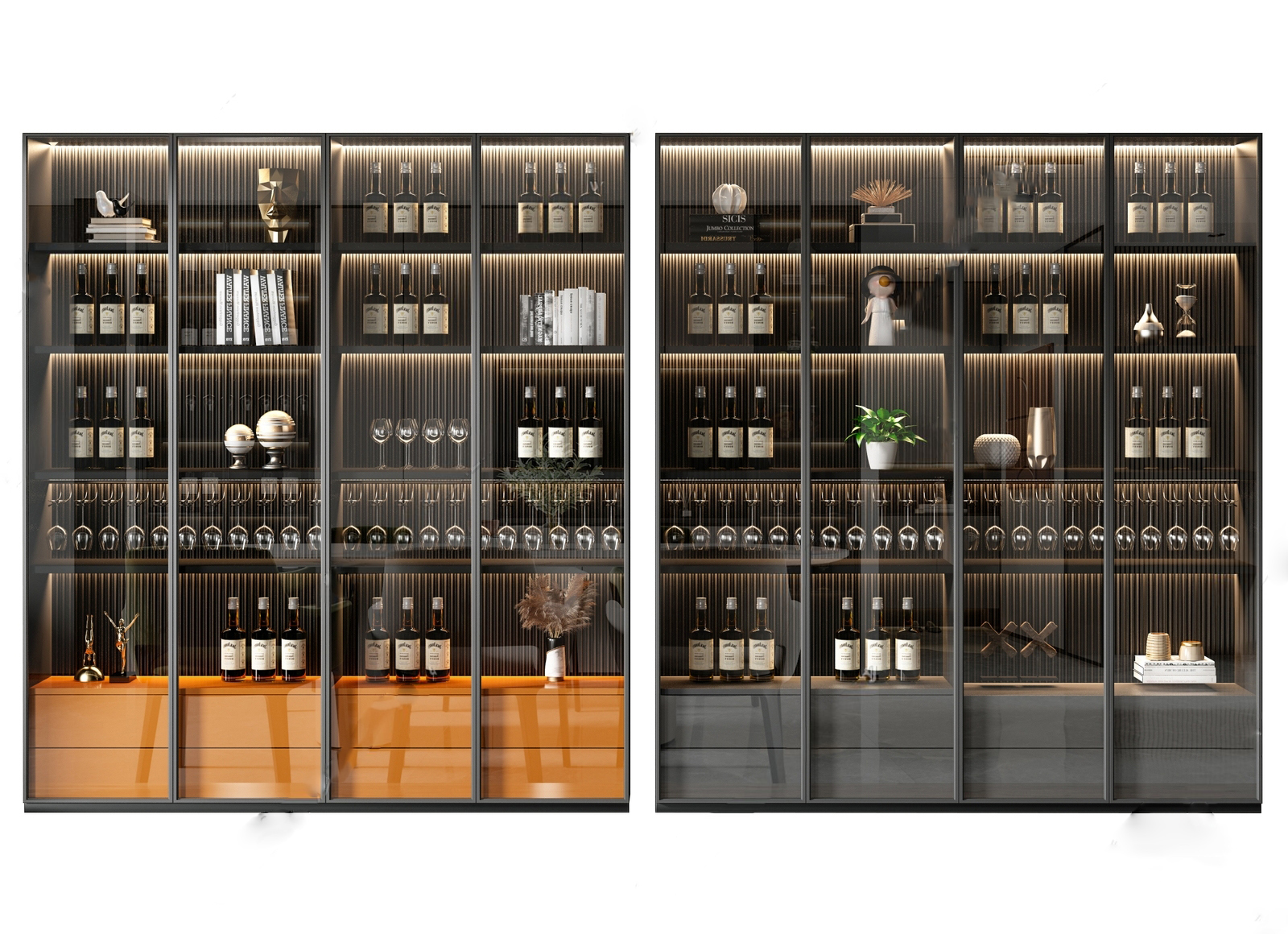
Spec the Materials Right: Key Materials for Minimalist Glass Wine Cellar Display Zones
- Glass: Dual-seal insulated glass units (double-glazed) + Low-E coating + tempered safety rating is the recommended baseline. Thickness references in the ~12 mm class for the insulated unit yield noticeably better thermal transfer resistance and structural steadiness.
- Frame Members: Stainless steel or anodised aluminium first—moisture-resistant, dimensionally stable, and they "hold form" long-term in humid air.
- Racking / Shelving: Metal or acrylic aligns best with modern minimalism; the priority is zero warping, zero coating peel, and zero odour transfer in humid conditions.
- Seal System: Premium silicone + magnetic gasket sets are non-skippable—once air infiltration slips out of control, energy waste and persistent condensation will haunt the setup.
- ❌ Common Mistake: Substituting in "looks similar" cheaper extrusion profiles. Save a little now, pay for regasketing, straightening warps, and wiping fog off glass forever.
Integrate the Vision: Embedding Glass Wine Cellars into Singapore Homes
A truly high-end wine cellar doesn't sit as a standalone object—it reads like it was born out of the wall itself.
- Living Room Focal Point: Use the glass wine cellar as a spatial divider (e.g., half-height partition / flush-built feature wall), making the collection the atmospheric centrepiece of your entertaining zone.
- Under-Stair Vertical Stack: Many Singapore layouts have irregular under-stair voids—packing that volume with a compact-yet-vertical glass-fronted wine wall reads as an unexpected luxury.
- Kitchen-Dining Continuity: Embed the wine cellar into the tall-cabinet run so pour distance is short and you avoid thermal radiation from the cooktop zone.
Compact / Apartment Strategy:
Go flush-embedded + vertical racking layouts to maximise bottle count per square foot; fold smart controls (temp/humidity monitoring, lighting scenes) into the home system for remote checks and scene switching—the whole thing starts feeling like a boutique hotel.
- ❌ Common Mistake: Placing the wine zone in a high-traffic dead corner or right next to a west-exposed curtain wall / glass façade with afternoon solar gain.
- ✅ The Safer Route: Position it where the home stays relatively cooler, less sun-blasted, and thermally steadier—then reinforce the adjacent wall or glazing's thermal envelope accordingly.
Understanding the Investment: Price Ranges and Value for Custom Wine Cellars in Singapore
Custom wine cellar cost is driven by footprint volume, glass & frame specification, HVAC (climate-control) equipment, lighting & smart controls, and on-site building/electrical adaptation complexity. Reference ranges cited:
- Entry-level custom builds can start from around SGD 10,000;
- More exacting luxury executions can exceed SGD 50,000;
- Example benchmark cited: a ~200-bottle capacity scheme using imported material systems and higher-spec glass/sealing comes in around the SGD 35,000 order of magnitude.
| Comparison Axis | Custom Glass Wine Cellar | Standard Wine Fridge / Cabinet |
|---|---|---|
| Capacity | Scales with your available space (fully customisable) | Capped by model size |
| Visual Integration | Seamlessly fused with interior architecture | Reads as a standalone appliance |
| Service Life | Higher (long-term asset quality) | Moderate |
| Design Freedom | Near-limitless | Essentially none |
The MRETTY Advantage: Precision Detailing in Singapore's Custom Furniture Landscape
Led by veteran Chief Designer Aida, the team knits "aesthetic expression" to "engineered reliability": we've delivered extensively across Singapore's local custom-interior landscape, and specialise in pre-empting hidden failure modes at the design stage—condensation-prone edges, thermal leak paths, frame-warping-from-humidity risks—so the result isn't just a beautiful render, but a system that stays dependable years later.
Conclusion: Raise Your Home's Standard with MRETTY
A minimalist glass wine cellar display zone is a serious investment: it has to safeguard your collection and elevate your home's bearing. Don't leave critical junctions to chance. Partner with a team that understands Singapore's climate, speaks the language of minimalist detailing, and delivers true integrated customisation—and the outcome stays solid.
MRETTY: Premium Bespoke Kitchen & Cabinet Systems Provider in Singapore
